From the Washington Examiner:

In 1997, legendary journalist Robert Novak summed up renewed interest in the Right-to-Work issue thusly: “It’s so old-fashioned it’s a brand new idea.”

Over a decade later, that observation still rings true. Faced with intractable budget crises and Big Labor power grabs, states are increasingly turning to an old solution — Right-to-Work laws — to protect worker freedom and jump-start their troubled economies.

Thirteen states recently introduced Right-to-Work legislation to ensure no worker can be forced to join a union or pay union dues as a condition of employment, and a number of others may soon join them.

In New Hampshire, a Right-to-Work bill has already sailed through the lower chamber. In Indiana, another Right-to-Work bill was in the offing until Gov. Mitch Daniels abruptly decided he had “other priorities.” Apparently, freedom of association didn’t merit inclusion in Daniels’ supposedly “bold” governing agenda.

Meanwhile, several Michigan lawmakers are considering special “Right-to-Work zones” in a state long considered a bastion of forced unionism. While hardly adequate to fully protect employee choice, these embryonic reform proposals point to a significant shift in state labor politics.

The impetus behind this wave of Right-to-Work legislation isn’t a mystery: Big budget deficits, declining revenues and slumping economic growth have forced many states to reconsider their fiscal priorities, while a prolonged recession has legislators scrambling for policies with a proven record of job creation.

Fortunately, renewed interest in Right-to-Work happens to coincide with a historic opportunity. In November, voters across the country kicked many of Big Labor’s loudest forced-unionism apologists out of statehouses, where they once wielded tremendous power to obstruct or block Right-to-Work legislation.

The logic of state Right-to-Work laws is ironclad: Not only is safeguarding worker freedom the right thing to do, it also yields tremendous economic benefits. Recent studies from the Cato Institute and the National Institute for Labor Relations Research suggest that Right-to-Work states enjoy higher job growth and more cost-of-living-adjusted disposable income for workers than their forced-unionism counterparts.

They also seem to be weathering the recession better than old Midwestern industrial bastions like Michigan, Illinois and Indiana, states that lack protections for individual workers’ rights. (Click to read full article)

Op-Ed by Mark Mix is president of the National Right-to-Work Committee.

Share

Department of “Organized” Labor

The Department of Labor is supposed to protect the 90% of workers who are not members of labor unions, as well as the 10% who are.  But the Secretary of Labor appears to have never gotten the message.  Speaking to the Democratic National Committee, Hilda Solis made it clear she cares only for the unionized workforce.  But even then she doesn’t even speak for the majority of union workers as she opposes giving them the right to choose to be a member of organized labor.  From the Examiner:

The problem is that her DNC remarks made clear that Solis labors under the flawed assumption that she represents only the steadily dwindling sliver of the American work force that is still unionized. As a result, Solis is leaving the other 90 percent of American workers high and dry.

Here’s the key passage from Solis’ remarks at the DNC on public employee protests in Wisconsin and Ohio that points to her fractured understanding of whom she represents: “The fight is on. We work together. We help those embattled states right now where public employees are under assault.” She called members of the protesting public employee unions “our brothers and sisters” and pledged to help them against Republican Govs. Scott Walker of Wisconsin and John Kasich of Ohio. With those remarks, Solis effectively put the federal government in the de facto position of aiding protesters opposing governors doing what they were elected to do less than five months ago.

As The Washington Examiner’s Byron York pointed out Monday, the Labor Department’s mission statement says it is supposed to “foster, promote, and develop the welfare of the wage earners, job seekers, and retirees of the United States.” There is nothing in the statement about taking the union side in collective bargaining conflicts, much less about deploying her department’s 17,000-plus civil servants for or against either side in any labor-management compensation dispute, much less one between a sovereign state and its workers.

Share

“Craig Becker will no longer be a secret weapon at the NLRB”

You need to install or upgrade Flash Player to view this content, install or upgrade by clicking here.

ACORN Founder Wade Rathke regarding SEIU Lawyer Craig Becker’s appointment to the five-member National Labor Relations Board once wrote:

“Thanks for a solid, President Obama!” And, “Craig Becker will no longer be a secret weapon for workers [read SEIU & AFL-CIO bosses] at the NLRB…” 

Rathke is right, Becker is no secret and, according to Washington Examiner’s Mark Hemingway and the National Right to Work Legal Defense Foundation, he appears to be willing to violate ethical restrictions to help his “former employer SEIU.

From Hemingway’s 12/10/2010 story:

National Labor Relations Board member Craig Becker recused himself from a decision earlier this week that advanced organized labor’s top public policy goal, Card Check, but worries continue to grow in at least a dozen other cases before the board in which he participated despite apparent conflicts of interest for the former labor lawyer.

Becker recused himself from the case because he had written a brief supporting labor prior to joining the board.

Card Check is a bullying tool used by unions that … exposes workers to threats and actual physical intimidation by union organizers.

Becker refused to discuss the case with the Examiner or his rationale for recusals, as did a board spokesman.

Since joining the NLRB, the National Right to Work (NRTW) Foundation has filed 13 motions noting Becker’s conflict of interest in cases before the NLRB.Since joining the NLRB, the National Right to Work (NRTW) Foundation has filed 13 motions noting Becker’s conflict of interest in cases before the NLRB. (more…)

Share

President Obama (D-IL), House Speaker Pelosi (D-CA), and Senate Leader Reid (D-NV) are risking the nation’s fiscal health to payback Big Labor Bosses for forced-union-dues financed political campaign operations.  Michael Barone in the Washington Examiner:

Starting around 1980, the country began to revive. Big Government lowered taxes and deregulated transportation and communications. Entrepreneurs and investors replaced stodgy corporate management with new companies and new products.

The conformist “organization man” Americans of the 1950s were replaced by nonconformist innovators, risk-takers and creators who created a new economy that central planners could never have envisioned. Bill Gates and Steve Jobs didn’t wait for those at the top of Big Units to tell them what to do.

Big Business changed: The Fortune 500 list of 2010 doesn’t look anything like that of 1970.  … Most union members today are public employees.

The Obama Democrats, faced with a grave economic crisis, responded with policies appropriate to the Big Unit America that was disappearing during the president’s childhood.

Their financial policy has been to freeze the big banks into place. Their industrial policy was to preserve as much as they could of General Motors and Chrysler for the benefit of the United Auto Workers. Their health care policy was designed to benefit Big Pharma and other big players. Their housing policy has been to try to maintain existing prices. Their macroeconomic economic policy was to increase the size and scope of existing government agencies to what looks to be the bursting point.

What we see is Big Government colluding with Big Business and trying to breathe life into Big Labor.

Share

When Big Labor plays with fire, taxpayers get burned

Empire State pupils enrolled in K-12 public schools fell by more than 121,000 over the last 10 years, schools added 14,746 teachers and 8,655 non-teaching professionals to their payrolls

 NRTW President Mark Mix commentary in the Washington Examiner:

July 8, 2010 Near midnight last Thursday, House Speaker Nancy Pelosi and her fellow forced unionism apologists in the U.S. House of Representatives disgracefully amended a “must-pass” war funding bill to include language that is designed to force police officers, firefighters, and Emergency Medical Technicians (EMTs) into “exclusive” union bargaining in every state in the country.

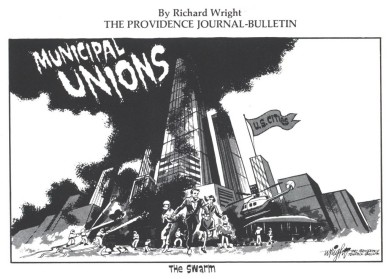
It doesn’t take a rocket scientist to figure out that policies expanding public sector monopoly unionism have played a major role in driving many states to the verge of insolvency. (more…)

Share