Right to Work is right for Virginia

From the Richmond Times by NRTW President Mark  Mix:

Weathering an economic downturn is never easy, but some states are managing better than others.

Despite the recession, Virginia boasts a modest unemployment rate, and its average hourly wages top the national mean. What’s the Old Dominion’s secret? One factor that sets Virginia apart from its less fortunate neighbors is the state’s popular Right to Work law.

Virginia’s Right to Work law ensures that no employee can be forced to join or pay dues to a union just to get or keep a job. Protecting employee choice has always been the most important argument in favor of Right to Work, but Virginia’s economic performance is another point for worker freedom.

Recent studies from the Cato Institute and the National Institute for Labor Relations Research indicate that right-to-work states enjoy higher job growth and more disposable income (after adjusting for families’ cost-of-living) than their forced-unionism counterparts.

Eight of the top 11 states for wage and salary growth enjoy right-to-work protections. Meanwhile, 13 of the 14 worst performers lack right-to-work laws.

Workers and their families are also voting with their feet: According to the National Institute for Labor Relations Research, the young adult population in forced-unionism states has basically stagnated since 1980. Virginia, on the other hand, continues to attract a stream of new workers and entrepreneurs.

Protecting worker freedom also prepares states to handle a difficult recession better than their forced-unionism counterparts.

Virginia’s robust job and wage growth compares favorably with the sluggish performance of union-dominated states like Michigan, Illinois and Wisconsin. (more…)

The BNA news service reports that the attorneys general of South Carolina, Alabama, Arizona, Florida, Georgia, Nebraska, Oklahoma, Texas, and Virginia are challenging the NLRB’s overreach in its attempt to circumvent state Right To Work laws: 

The attorneys general of nine states April 28 sent a letter to National Labor Relations Board Acting General Counsel Lafe E. Solomon asserting that his approval of an unfair labor practice complaint challenging Boeing Co.’s decision to establish airplane production in South Carolina was an “ill-conceived retaliatory action” that “seeks to destroy our citizens’ right to work” and asking him to withdraw the complaint immediately.

The letter came a week after Solomon announced the issuance of a complaint alleging that Boeing illegally transferred some of the production of its 787 Dreamliner and related supply operations to South Carolina because Washingtonbased employees represented by the International Association of Machinists have in past years engaged in lawful strikes over contract disputes with the company (77 DLR AA-1, 4/21/11).

Gov. McDonnell attributes Virginia’s balanced budget to Right To Work

Click image to contact Gov. Walker

Subscribe to The National Right to Work Committee® by Email

According to Fox News’ Judson Berger, “Wisconsin Union Battle Could Set Stage for National ‘Right To Work’ Debate.”  More from Berger’s article:

The standoff in Wisconsin over the benefits and rights of public employees could for the first time in decades spur changes across the country over so-called “right-to-work” laws — or laws that prohibit unions from forcing workers to join.

Along with requiring public employees to contribute more to pensions and health care coverage, Wisconsin Gov. Scott Walker wants to put his state in the right-to-work column. His proposals have touched off an epic battle in Madison between pro-labor Democrats and Republicans who say they’re just trying to balance the budget. 

And now that battle is spreading.

Throngs of union members and supporters gathered in Indianapolis Monday for a protest against a proposed bill in the Indiana House that would restrict collective bargaining rights and make it a misdemeanor to require any employee to join or pay dues to a union.

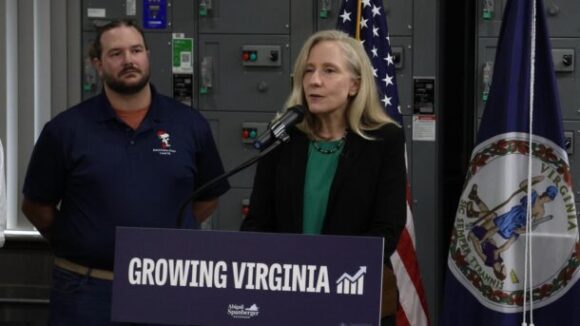
Click image to contact Gov. McDonnell

Virginia Gov. Bob McDonnell, in an interview with Fox News on Monday, directly attributed Virginia’s ease in balancing its budget to the fact that it is a right-to-work state.

“We’re a right-to-work state, so I don’t have a lot of the challenges that (Walker) has in Wisconsin,” McDonnell said. Virginia is nevertheless considering a proposal to add a right-to-work provision into the state’s constitution.

“Unlike in federal government, we’ve got to balance our budgets,” McDonnell said.

Owners of GM, Chrysler Tap UAW Strike Fund to Tackle Right To Work

UAW and BMW plan to expand in Right To Work state of South Carolina

Union bosses at the United Autoworkers Union are tapping worker’s strike funds to fund a crusade to force auto workers in Right to Work states into the UAW.  The UAW is literally dying on the vine and with two of the Big Three auto companies forced into bankruptcy.  The UAW’s actions are a real threat to the jobs of workers at BMW, Toyota, Hyundai and VW.  The Wall Street Journal has the story.

Change in Wisconsin

 Newly elected Wisconsin Governor Scott Walker is not backing down from a fight to protect taxpayers.  Walker has proposed reforming the state’s collective bargaining laws to protect taxpayers.  The Wall Street Journal takes note: 

Wisconsin Governor-elect Scott Walker has laid out an ambitious agenda, such as turning the department of commerce into a public-private partnership and lifting the cap on school vouchers. But his boldest idea may be rescinding the right of government employees to collectively bargain.

Mr. Walker floated the idea last week in response to union opposition to his modest proposal to require employees to contribute 5% of their pay to their pensions and to increase their health-care contributions to 12% from as low as 4% today. Even along the Left Coast most state workers contribute 10% of their salary to pensions. The Republican estimates that these changes would save the state $154 million in the first six months. Over two years they’d reduce the state’s $3.3 billion budget gap by nearly 20%.

The ability of public workers to form unions and bargain collectively is a phenomenon of the last century when state and local governments were relatively small. But it has proven to be a catastrophe for taxpayers, as public unions have used their political clout to negotiate rich deals on wages, pensions and health care. California governor-elect Jerry Brown greased the wheels for his state’s long fiscal decline when he allowed collective bargaining during his first stint in the statehouse in the 1970s.

Republican Governor Mitch Daniels of Indiana and then Governor Matt Blunt of Missouri rescinded collective bargaining by executive order in 2005, and the change made it easier to cut spending and restructure government services. In Wisconsin, the legislature would have to rewrite the Employment Labor Relations Act, but Republicans will control both the assembly and senate and have the political incentive to go along with Mr. Walker.Rescinding public collective bargaining rights restores a better negotiating balance between taxpayers and government employees who ostensibly work for them. Political officials are no longer on both sides of the bargaining table—representing taxpayers in negotiations with the unions while seeking union cash and endorsements when running for re-election. (more…)

Right to Work States Perform Better

Mark Perry looks at the economic performance of Right to Work states in comparison to forced unionism states and provides further evidence that Right to Work states foster prosperity.  In the economic downturn year of 2009, forced unionism states economic growth fell by 2.42% but in Right to Work states, it only decreased 1.66%.

As Perry states, “In other words, the decline in economic growth growth in forced unionism states (-2.42%) was 0.76% worse in 2009 than the decline in right-to-work states (-1.66%).  Further, of the ten states that experienced positive growth in 2009, only two were forced unionism states (Alaska and W. Virginia) and eight were right-to-work states (Nebraska, N. Dakota, S. Dakota, Arkansas, Louisiana, Virginia, Oklahoma and Wyoming).  The three top states with the highest growth in 2009 were all right-to-work states: Oklahoma (6.6%), Wyoming (5.4%) and North Dakota (3.9%). “

Right To Work Helps Fuel the Jobs Engine

The publisher of Virginia Business, Bernie Niemeier, reminds readers among the natural advantages of states  such as  California, New York and Virginia it is often the “legal advantages”  ”like being the northernmost Right To Work state and having reasonable tort laws and a relatively low corporate income tax rate” that separates Virginia from the pack.

Excerpts from Niemeier’s  editorial, Job creation is fueled by existing business expansion:

Over the past few years, Virginia’s economic development news has been full of big marquee names: Volkswagen, Altria, Hilton, SAIC, Northrop Grumman and others. The commonwealth has held a winning hand in the high-profile game of attracting corporate headquarters from California, New York and other states.

Natural advantages such as the Port of Virginia, Dulles Airport and proximity to Washington, D.C., are important parts of our success. Legal advantages — like being the northernmost right-to-work state and having reasonable tort laws and a relatively low corporate income tax rate — also make Virginia an attractive place to do business.

When high-profile new business announcements are made, many take credit and rightfully so. Major out-of-state and international relocations involve the governor’s office, the Virginia Economic Development Partnership (VEDP), regional economic development alliances and local-level economic development offices.

We’ve been a little less than humble in continually reminding ourselves and others of our reputation as the best-managed state, one of the best states in which to do business and the most business-friendly state, among other accolades.

But perhaps Virginia’s existing businesses have been too humble in taking credit for the jobs their expansion and growth have created, especially during difficult economic times. In fact, existing businesses have led the commonwealth in job creation over the past several years. (more…)