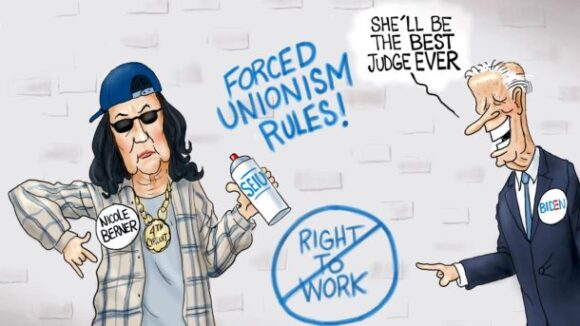
After carrying their water for three years and enacting a government-run health care program that will give the SEIU union bosses the opportunity to forcibly unionize hundreds of thousands of health care employees, the SEIU has said thank you to the president by giving him an early endorsement for re-election campaign.
Outrageous. That is the only way to describe the SEIU’s latest scheme to paid their coffers:
If you’re a parent who accepts Medicaid payments from the State of Michigan to help support your mentally-disabled adult children, you qualify as a state employee for the purposes of the Service Employees International Union (SEIU). They can now claim and receive a portion of your Medicaid in the form of union dues.
Robert and Patricia Haynes live in Michigan with their two adult children, who have cerebral palsy. The state government provides the family with insurance through Medicaid, but also treats them as caregivers. For the SEIU, this makes them public employees and thus members of the union, which receives $30 out of the family’s monthly Medicaid subsidy. The Michigan Quality Community Care Council (MQC3) deducts union dues on behalf of SEIU.
Michigan Department of Community Health Director Olga Dazzo explained the process in to her members of her staff. ”MQC3 basically runs the program for SEIU and passes the union dues from the state to the union,” she wrote in an emailobtained by the Mackinac Center. Initiated in 2006 under then-Gov. Jennifer Granholm, D-Mich., the plan reportedly provides the SEIU with $6 million annually in union dues deducted from those Medicaid subsidies.
“We’re not even home health care workers. We’re just parents taking care of our kids,” Robert Haynes, a retired Detroit police officer, told the Mackinac Center for Public Policy. “Our daughter is 34 and our son is 30. They have cerebral palsy. They are basically like 6-month-olds in adult bodies. They need to be fed and they wear diapers. We could sure use that $30 a month that’s being sent to the union.” (more…)
Big Labor continues to fund and support the radical “Occupy” strategy with the announcement that the SEIU union in California has joined the Los Angeles protest. The union bosses are protesting to demand another taxpayer bailout for government workers contained in the Obama “jobs” bill.
MRC-TV reports on a mob of SEIU activists taunting and intimidating security guards who are not members of a union. The tactics come on the heal of the shooting of a small business owners for the same reasons.
Let’s just say that the SEIU Manual describing how union activists can pressure and intimidate workers into accepting forced unionism has gone viral with the American Spectator‘s Ivan Osorio & Adam Michel are the latest to have a look at the shocking details:
The SEIU manual instructs union activists on how to conduct a “corporate campaign.” This consists of a union pressuring an employer to give in to worker demands by employing aggressive methods, including generating negative media coverage, filing complaints with regulators, and disrupting relationships between businesses and their customers, vendors, and lenders.
A union conducting a corporate campaign will often enlist the help of third parties sympathetic to the broader progressive agenda — environmental activists, consumer groups, “human rights” advocates, and the like. For instance, an environmental group sympathetic to the union might accuse the company which the union is targeting of polluting, while the union itself might go after the firm’s access to capital by attacking its creditworthiness.
It also encourages workers to lower their productivity, stating, “In many cases, the most powerful worksite tactic is for members to do only what they are required to do by the union contract and no more.” If reducing productivity is not enough, SEIU then calls for personal attacks on managers, encouraging workers to make “life more difficult for them as individuals,” through such methods as leafleting outside of their homes and at community gatherings.
The SEIU manual instructs union activists how to disrupt their employer’s operations, undermine company profits, and even harass managers at their homes and in their communities.
In a corporate campaign, the union’s message to the employer is clear:Agree to our demands or we’ll drag your reputation through the mud. When the employer relents, the attacks cease.
The discovery of an SEIU intimidation guidebook has led the Washington Examiner to make the compelling case that the SEIU should not be above the law:
Imagine the outcry if managers of a company trying to fight off a union seeking to organize its employees used the following tactics:
- Stage regular mass visits or sit-ins using paid protesters at the union’s headquarters to prevent its officials from doing their work.
- Organize constant telephone calls to targeted union officials to harass them into backing off their campaign.
- Plant negative stories about the union to jeopardize its relationships with managers and owners of community institutions the union must depend on to maintain daily operations, including banks or credit unions, office suppliers, caterers, utilities, and landlords.
- Use friends and allies in government to generate costly legal and regulatory pressure on the union.
- Plant negative stories about the union and its officials with local media.
- Encourage employees who support management to use civil disobedience tactics to disrupt all attempts by the union to meet with or otherwise communicate with other employees in the workplace or elsewhere.
- Promise informants protection from retaliation for providing “dirt” that can be used to compromise union leaders during negotiations, or embarrass them in public with their friends and families.
Any company engaging in these sorts of tactics would be quickly forced to explain itself before the National Labor Relations Board, which would almost certainly impose a costly sanction after finding the firm guilty of unfair labor practices. As it happens, all of these tactics, and many more as bad or worse, are described by and endorsed in a training manual used by officials of the Service Employees International Union in preparing members for campaigns against targeted companies.