Public Sector Unions Bankrupt the Golden State


The City Journal looks at the incestuous relationship between Big Labor and big government in California.  The results are not pretty.

Share

Three Reasons Government Union Bosses Hurt the Economy

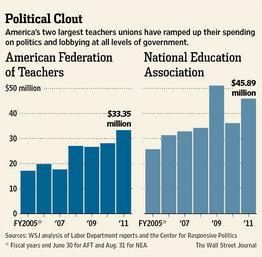
ReasonTV takes an in depth look at growth public sector unions even during the economic recession. How can they grow at that pace? Listen the the boss of the teacher’s union: “We are twisting arms; we are threatening people.”

Share

Government Unions Get Rich; Taxpayers Get Poor

In the midst of a recession, while Americans are tightening their belts, big labor unions monopoly bargaining privileges are taking taxpayers for a ride.

The Examiner examines the data:

For decades, public sector unions have peddled the fantasy that government employees were paid less than their counterparts in the private sector. In fact, the pay disparity is the other way around. Government workers, especially at the federal level, make salaries that are scandalously higher than those paid to private sector workers. And let’s not forget private sector workers not only have to be sufficiently productive to earn their paychecks, they also must pay the taxes that support the more generous jobs in the public sector.

Rather than reforming the system, some members of Congress are pushing a scheme to force even more public employees,  police and fire fighters, under union monopoly control.  It’s time we trim the forced unionism power of government employee union officials before the country goes bankrupt.

Share

Christie Fights Government Union Excesses

New Jersey Gov. Chris Christie is taking on the government unions head on.  George Will describes the financial situation in New Jersey as “the nation’s worst.”  Christie has issued executive orders that have saved $2.2 billion in state spending but he won’t be able to get things under control unless he reforms the gold-plated benefits of the government employee unions’ and that is what he is doing.  Wonder if the governors of other states — including Arnold Schwarzenegger — are paying any attention.

So he closed the $2.2 billion gap by accepting 375 of 378 suggested spending freezes and cuts. In two weeks. By executive actions. In eight weeks he cut $13 billion — $232 million a day, $9 million an hour. Now comes the hard part.

Government employees’ health benefits are, he says, “41 percent more expensive” than those of the average Fortune 500 company. Without changes in current law, “spending will have increased 322 percent in 20 years — over 16 percent a year.” There is, he says, a connection between the state’s being No. 1 in total tax burden and being No. 1 in the proportion of college students who, after graduating, leave the state.

Partly to pay for teachers’ benefits — most contribute nothing to pay for their health insurance — property taxes have increased 70 percent in 10 years, to an average annual cost to homeowners of $7,281. Christie proposes a 2.5 percent cap on annual increases.

Share

Andy Stern’s Warped View

Andy Stern is living in a world of delusion.  According to the soon-to-be retiring union boss and President Obama confidant, forced unionism “is the greatest middle-class, job-creating mechanism that we have ever had in America that doesn’t cost tax payers a dime.”

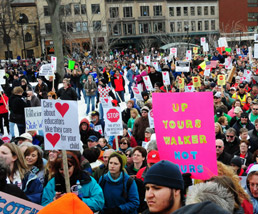
Is he kidding?  From Project Labor Agreement kickback schemes to bailouts of mismanaged union pension funds, Big Labor has become a drain on taxpayers.  Who was it that was rallying in front of the capitol building in Illinois this week chanting for higher tax rates for government union member raises?  Public workers union bosses are bankrupting the country.  Mr. Stern, who do you think pays their salaries and benefits packages?

Share

(Source: March 2010 Forced-Unionism Abuses Exposed)

Chris Christie, New Jersey’s freshly minted GOP governor, made national news on February 11 in an address to the state Legislature regarding his proposal to balance the Fiscal Year 2010 budget, which is, as he pointed out, “in shambles.” Gov. Christie pushed for $2 billion in spending cuts just for the remaining four-and-a-half months of FY 2010.

Why isn’t he following in the footsteps of previous New Jersey governors in both parties who raised taxes and/or tinkered with fiscal timetables when faced with large budget deficits? “The old ways of doing business have not served the people well,” explained the governor.

Mr. Christie was surely right about that. The Garden State now stands before a fiscal abyss not primarily because of the recent national recession, but because New Jersey’s heavily unionized public sector has for many years been sucking resources and vitality out of the state’s beleaguered private-sector employees and businesses.

For example, during the five years from 2003 to 2008, even as the national economy boomed, New Jersey’s private-sector employment grew by a total of just 1.5%, roughly a quarter of the national average. Meanwhile, state and local government jobs in New Jersey (more than two-thirds of them under union monopoly-bargaining control) soared by 5.9%, nearly four times New Jersey’s private-sector job growth.

And it’s not just the wages, salaries and benefits of active unionized government employees that are growing far more rapidly than those of private-sector employees. A large and rapidly growing share of public-employee compensation costs for New Jersey’s taxpaying individuals and firms come from outsized public pension and retirement-health benefits.

Union negotiators with monopoly-bargaining privileges, as well as Big Labor lobbyists and the politicians who do their bidding, have over the years established policies in New Jersey that encourage a wide array of healthy public employees to retire while they are still in their early fifties with pension and health benefits worth $100,000 or more a year.

No wonder New Jersey’s property taxes in 2009 were an average of nearly $7300, the highest in the nation and more than 70% higher than they had been just a decade earlier. No wonder New Jersey’s business tax climate was the worst in the nation both this year and last year, according to the nonpartisan Tax Foundation. No wonder, in 2009, Chief Executive ranked New Jersey a dismal 48th out of the 50 states for doing business, based on a survey of 543 CEOs.

Unless New Jersey’s elected officials can resolve to curtail sharply the growth in the cost to taxpayers of unionized government employees’ and retirees’ compensation, the state faces a very bleak economic future and possibly even bankruptcy.

The budget reforms announced and recommended by Mr. Christie in his February 11 address to the Legislature, including a freeze on expenditures of over $550 million in unspent funds for the rest of FY2010 and raising public-employee contributions to pension and other benefit funds, together constitute a modest step in the right direction, but no more than that.

And at this writing it is still unclear whether the Big Labor-dominated New Jersey Legislature will adopt even the tentative public spending reforms that are now on the table.

In a February 28 editorial, Newark’s Star-Ledger, New Jersey’s largest local newspaper, glumly but realistically predicted: Union officials “will treat this as a life-and-death fight. They will spend millions on radio and TV ads and bumper stickers. They will mobilize lobbyists. They will activate their fleets [of union militants].”

By all appearances, government union bosses in New Jersey do not care whether or not the state goes under.

Their intransigence makes it more obvious than ever before that all realistic, long-term solutions for New Jersey’s government-spending crisis must involve rolling back public-sector union officials’ special privileges, including, first and foremost, the monopoly privilege to speak for all front-line employees, including those who choose not to join the union and want nothing to do with it, regarding workplace issues.

Despite his evident good intentions, Chris Christie has yet to demonstrate he is prepared to fight to narrow and, ultimately, eliminate government union chiefs’ monopoly-bargaining powers. But unless he does take on that fight, his efforts to bring New Jersey back from the brink are almost certainly doomed to fail.

Share