Heritage Foundation: Right to Work Creates Jobs and Choice

James Sherk of the Heritage Foundation confirms what we have known for decades, enacting Right to Work laws create jobs and promote choice for workers:

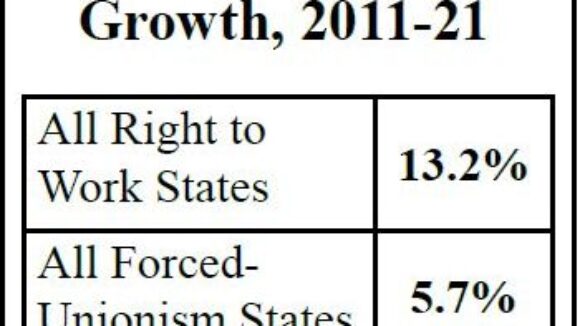
Union contracts frequently require employees to pay union dues or lose their jobs. This forces workers to support the union financially even if the union contract harms them or they oppose the union’s agenda. Several states, including New Hampshire and Indiana, are considering right-to-work laws, which protect workers from being fired for not paying union dues. Unions oppose these laws because they reduce union membership and income. However, the rest of the economy benefits from right-to-work laws.

States can and should reduce unemployment by becoming right-to-work states.

Right-to-Work

Unions often negotiate contracts requiring all workers to pay union dues or lose their jobs, whether or not they support the union. But many workers reject unions. Some do so because union contracts reduce their pay. Others oppose unions’ political agendas: Unions almost exclusively support Democrats, despite 37 percent of their members voting Republican in the last election.[1]

To prevent workers from being forced to support unions financially, 22 states have passed right-to-work laws. Such laws prevent companies from firing workers who do not pay union dues. Workers may still pay voluntarily, but unions cannot threaten their jobs if they do not join. Lawmakers in several states, including New Hampshire, Indiana, and Michigan, are considering right-to-work bills.

Forced Unionization Is Not an American Value

The government should not force workers to pay for unwanted union representation. In a free society, workers alone should make that choice. Right-to-work laws also make good economic sense. They reduce the incentive for union organizers to target companies that treat their workers well. Since unions hurt businesses, less aggressive union organizing attracts investment—and jobs.

Lawmakers considering right-to-work proposals should ignore the union movement’s self-interested opposition. Unions could negotiate contracts that apply only to their members—they simply prefer not to. Unions should not be able to force workers to choose between financially supporting them and losing their jobs.

Unions Lose Money When Workers Opt Out (more…)

Gov. Tim Pawlenty’s support for Right To Work ignited long and enthusiastic rounds of applause from the New Hampshire audience.

You need to install or upgrade Flash Player to view this content, install or upgrade by clicking here.
 

The state came close to living up to its motto when it passed, by large majorities, Right To Work legislation this Spring.  But, Big Labor Gov. John Lynch vetoed the legislation and chose to continue to allow union bosses to forcibly take union dues from New Hampshire workers’ paychecks.

However, New Hampshire legislators are preparing to override the Lynch veto of worker freedom. Before the summer is over, there could be a 23rd Right To Work State. Judging by the enthusiastic response in the debate, the veto override clearly has momentum.

Why the “Live Free or Die” state may continue to be mired in compulsory unionism according to the New Hampshire Watchdog’s Grant Bosse:

Right-to-work

Big Labor's Governor John Lynch endorses compulsory dues

The new dynamic has revealed itself most directly in the debate over right-to-work legislation. Having functionally taken over the Democratic Party, New Hampshire labor unions have drawn on a few Republican allies to try to sustain Gov. John Lynch’s veto.

Unions currently have monopoly bargaining power for all employees in unionized workplaces. They claim this burden justifies forcing union dues from unwilling workers. In fact, this monopoly prevents unions from having to compete at the bargaining table, driving wages and benefits higher.

Unions and their political allies think this is a good thing, while taxpayers end up paying more. Right-to-work would prevent workers from having to pay union dues as a condition on employment.

NH Gov Lynch: Compulsory Fees Are Freedom!!!

New Hampshire Governor Lynch claims that it is okay to force someone who is not party to a contract to be obligated under the private contract.

For Example: Let’s say Paul is hired by Peter to work. Brutus sees Paul earning money and wants a share. Brutus meets with Peter. Peter and Brutus make a private contract of the kind Gov. Lynch endorses. Peter agrees to pay Brutus a cut from Paul’s paycheck before he pays Paul.  The agreement cost Peter no more money, it gave Brutus some of Paul’s money and Paul gets less money for the same work, an amount exclusivley agreed upon by Peter and Brutus.  Gov. Lynch endorses the idea that Peter and Brutus can force Paul to pay Brutus against his will or lose his job.

This is what Governor Lynch wants to defend as freedom, compelling a third party (any employee) to be part of a private contract?

From National Review’s Brian Bolduc article, Work Free or Die:

New Hampshire is “an island of common sense” in blizzard-blue New England, state representative D. J. Bettencourt tells National Review Online. As the Republican majority leader in the state house of representatives, Bettencourt, along with Speaker William O’Brien, hopes to fortify this bastion of liberty’s defenses by passing a right-to-work bill.

Although H.B. 474 passed the Republican-controlled house by a hefty margin of 225 to 140, Gov. John Lynch, a Democrat, promised to veto it.

“We’re reaching out to members of the GOP caucus individually and making the case,” Bettencourt notes.

He makes two points in the bill’s defense: One, “the individual-freedom component,” is that “people who don’t want to join a union shouldn’t be forced to do so.” Two, New England is awash in government, and a right-to-work law would further distinguish New Hampshire from its left-leaning neighbors Vermont and Massachusetts. “To be a right-to-work state carries the potential to be a magnet for small businesses,” Bettencourt argues.

Governor Lynch retorts that the bill smacks of bureaucratic meddling in business decisions. “The governor has maintained for some time now [that] so-called right-to-work legislation has state government dictating to private businesses and their employees what should be included in a contract,” Lynch’s press secretary, Colin Manning, has said. Technically, the bill is written in such a way that it forbids private contracts from including provisions to mandate that employees join unions. [Is freedom from compulsion or mandates a bad thing?]

But Speaker O’Brien is having none of it. (more…)

Based on his April 12th press release remarking about New Hampshire’s March unemployment rate, Governor John Lynch has certainly been ignoring New Hampshire’s January “15-year High Unemployment” rate of “5.1%” (see WMUR link) and March’s 5.2% rate :

“We continue to see a steady drop in the unemployment rate here in New Hampshire, which is good news for our people, our businesses and our economy in general.

The impact of the national recession was felt by many New Hampshire families and businesses. That is why we must continue our successful economic strategy …”

Will Lynch ignore freedom, too? When Lynch vetoes the New Hampshire Right To Work law will he also claim that coercing people to pay to unions against their will continue New Hampshire’s long history of individual freedom? Forcing people to pay to have or keep a job creates a bar to employment; it will not decrease unemployment, nor is it freedom.  (Note: New Hampshire was free from compulsory unionism for over 150 years.)

New England Citizens for Right to Work Press Release:

Right to Work Passes General Court

Concord, NH – By a vote of 225 to 140, the New Hampshire House concurred with the Senate’s version of the New Hampshire Right to Work Bill (H.B. 474) today, sending the bill to Governor Lynch’s desk.

Once Governor Lynch receives the bill, he has 5 days to either sign the bill into law, let the bill become law without his signature or veto it and send it back to the General Court, where it will take a two thirds vote of each house to override his veto.

If the bill becomes law, New Hampshire would be the twenty-third state to pass a Right to Work law, which simply states that no worker can be forced to join or pay dues to a labor union just to have a job and feed their families.

Right now, over 68,000 workers in New Hampshire are forced to pay union dues as a condition of employment.

“A New Hampshire Right to Work law would simply restore workers’ ability to decide for themselves whether or not to join or pay union dues or ‘fees’ to a union official,” said John Kalb, Executive Director of New England Citizens for Right to Work.

Polls conducted in New Hampshire show that nearly 80% of Granite State citizens believe it is wrong to force workers to pay union dues just to get or keep a job.

Governor Lynch has publicly stated his intention to veto the bill.

Kalb said, “Governor Lynch has already promised his Big Labor benefactors that he will veto the Right to Work Bill. But if Right to Work supporters keep up the pressure, we have a good chance of overriding the Governor’s veto and making Right to Work the law of the land in New Hampshire. (more…)

Right to Work Passed New Hampshire Senate

With a veto proof margin, the New Hampshire State Senate has passed a Right to Work bill. The legislation now goes back to the House for a final vote. The fight, unfortunately, is not over.

Gov. John Lynch is a stalwart supporter of the union bosses and in return, the union bosses have flooded Lynch with political contributions.

If Lynch decides to veto the bill as promised, the House and Senate will need to override. Rest assured the union bosses and their ‘organizers’ will be out for all to see.

In an era of economic duress, New Hampshire is sending a message to employees and employers throughout New England – freedom and jobs go together.