Big Labor History Flashback

The American Federation of Teachers, AFL-CIO (AFT) which benefits dramatically from government employee forced dues at one time was opposed to representing both administrators and teachers.  From the New York Times, Aug 19, 1959 report from the AFT national convention held in Minneapolis, MN:

The American Federation of Teachers assailed the National Education Association today for what it termed “refusal to uphold” school desegregation decisions of the Supreme Court.

A Chosen Epithet “Company union” is an epithet the A. F. T. uses for the N. E. A., which represents school administrators as well as classroom teachers. The A. F. T. has 54,817 members, the N. E. A. about 700,000.

And, it opposed union financial disclosure known as the Landrum-Griffin Act.

It protested that the House passed Landrum-Griffin bill went far beyond the original intent of labor-management reform proposals by involving the Federal Government in the internal affairs of every union.


In New York state, a teacher who showed up late for class 101 times in a single school year and left early 47 times is still on the job.  Thanks to the monopoly bargaining power of the teacher’s union, she successfully fought the Department of Education’s attempts to fire her for 18 months and was able to return to the classroom.

The Albany Times Union reports that this teacher was not alone – She’s just one of hundreds of tenured teachers across the state who have kept their jobs despite poor performance and offenses that in many workplaces would be grounds for firing.

The story continues:

In fact, according to a state Education Department database obtained by the Times Union through a Freedom of Information request, it appears to be nearly impossible for a school district to fire a tenured public school teacher. The reason is twofold: job protection for unionized teachers is strong and the process for firing bad teachers — called a 3020-a hearing — is so drawn out and costly that most districts can’t afford it.

ecause it is so expensive and difficult, school districts outside of New York City are far less likely to even attempt to fire troubled educators although they enroll almost twice as many students, according to the comprehensive database of 2,087 3020-a hearings filed from 2006 to June 2011.

It’s cheaper to pay them a salary and stick them in a corner somewhere than go through the 3020-a process,” said Sharon Sweeney, executive director of the Four County School Boards Association, based in Wayne County. She said the 27 small districts she represents have only tried to fire about a dozen educators in 15 years, a number that does not reflect the reality of workplaces with thousands of employees.

Tagged with:
Posted in: Education, Public Employees, Teacher Unions

Teachers Pay the Price for Endorsement

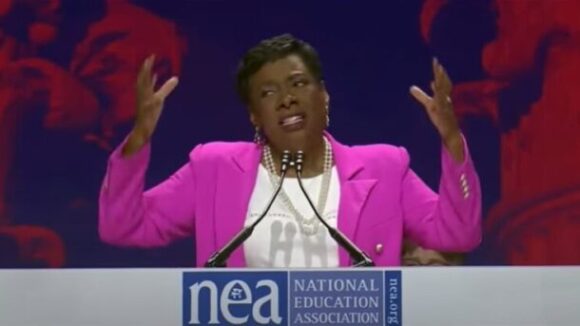
The National Education Association has gone all in for the president’s re-election but it is teacher’s who will be paying the price for the union bosses political gamesmanship.

The union has instituted a $10 a month tax to pay for their political propaganda.


Big Labor Political Money Bombs

Big Labor is “refocusing” their political spending – funded through forced labor dues — to defeat state legislators who voted for reform measures like those in Wisconsin. Some in the media are portraying this as bad news for national Democrats who receive upwards of 93% of all union contributions, but as the head of the National Education Association (NEA) says, ” we can multitask.”

Funds gained through a confiscatory scheme that does not give workers a choice or a say in the matter gives the union bosses the ability to spend an almost unlimited about on political campaigns — and spend they will. Big labor spent over $1 billion in politics in 2010 and will break all spending records in 2012. Larry Scanlon, the political director of the American Federation of State, County and Municipal Employees, says their spending alone will top the $90 million they spent last year.

NEA “We are at War”

No, the union bosses at the National Education Association are not talking about America bombing Libya but rather their declaration of war against politicians and taxpayers who question their ability to use the taxpayer spigot to fund their radical agenda. That’s why they are seeking to double their political budget through confiscatory union dues.

Some bills making their way through the Florida legislature are striking fear into the union bosses in Florida because it threatens big labor’s access to the wallets of teachers. One bill would would bar any public union from automatically deducting dues from members’ paychecks. Another would require unions to distribute annual reports on their financial activities. The abuse! The outrage! Making labor unions accountable to their employees and requiring them to collect their own dues money, rather than at taxpayer’s expense.

Government employee union woes are being felt from California to Maryland.  George W. Liebmann, executive director of the Calvert Institute for Policy Research Inc., lists several problems in Maryland in his Baltimore Sun op-ed:

Marylanders need instruction in how entrenched the state’s teachers’ unions are:

1. Eleven counties, including all the more populous ones, allow unions to collect “agency fees” from nonmembers, generating huge war chests. While in theory such fees are not supposed to be used for political purposes, a famous [NRTW] lawsuit in Washington state revealed that nearly 80 percent of “agency fees” are in fact so used.

2. The State Board of Education has only qualified authority over teacher certification. A special board, eight of whose 24 members are named by unions and six of whom are from teachers’ colleges, can only be over-ridden by a three-fourths vote of the State Board.

3. Under a law signed by Gov. Martin O’Malley last year, another special board, two of whose five members are named by unions, has the last word in resolving impasses in school labor negotiations.

4. Local union contracts impose maximums on the length of the school year, limitations originally derived from the needs of agricultural societies

5. Maryland’s charter school law is one of the few that binds charter school teachers to union contracts, and it provides few checks against refusal of applications by self-protective county boards.  Experimentation with “virtual schools” and distance learning is limited by a law binding employees to union contracts.

8. Contracts severely limit teacher attendance at PTA meetings, in some counties to two hours per year; and at post-school meetings, frequently to one hour a month. Evaluations and observations are severely limited; only a handful of teachers are ever found to be incompetent.

9. In all but three counties, third-party arbitrators, rather than the local board of education, are given the last word in grievance proceedings. There is a three-to-five step grievance procedure, making discipline of tenured teachers all but impossible. Out of a tenured force of more than 5,600, no more than two Baltimore City teachers were fired for cause, per year, between 1984 and 1990.

(more…)

NEA Doubles Dues for Politics

From Hot Air (http://hotair.com/archives/2011/02/26/nea-to-double-member-dues-contribution-to-political-war-chest/)

Amid substantial membership losses and a $14 million shortfall in its general operating budget, the National Education Association plans to double each active member’s annual contribution to the national union’s political and media funds.

Currently, $10 of each active member’s NEA dues is allocated to these special accounts. The more than $20 million collected each year is then disbursed to state affiliates and political issue campaigns – such as last year’s SQ 744 in Oklahoma. A portion of the money also pays for state and national media buys to support the union’s agenda.

But the most recent numbers show NEA lost more than 54,000 active K-12 members since this time last year. Coupled with less-than-expected increases in the average teacher salary – upon which NEA dues are based – the union will find itself with $14 million less revenue than it had planned. This includes about $500,000 less in the political and media funds.

Faced with unfriendly legislatures and governors seeking to roll back the union’s influence, the NEA Executive Committee decided to double down – literally. It proposed raising each active member’s assessment to $20, effective in September 2011. The union’s board of directors ratified the decision, and it will go before the NEA Representative Assembly for a vote this July in Chicago. If passed, NEA’s national dues for teachers will total $178.

The increase in the assessment has a five-year sunset clause, but this is just eyewash, since the last time the contribution was doubled – from $5 to $10 in 2004 – it also had a five-year sunset clause. The 2007 NEA Representative Assembly made the $10 contribution permanent.

NEA is already the top political campaign spender in the nation. This increase will give the national union an additional $40 million per election cycle. The increase alone is larger than all but two other groups spent during the entire 2007-08 cycle.

Subscribe to The National Right to Work Committee® by Email