Right to Work is right for Virginia

From the Richmond Times by NRTW President Mark  Mix:

Weathering an economic downturn is never easy, but some states are managing better than others.

Despite the recession, Virginia boasts a modest unemployment rate, and its average hourly wages top the national mean. What’s the Old Dominion’s secret? One factor that sets Virginia apart from its less fortunate neighbors is the state’s popular Right to Work law.

Virginia’s Right to Work law ensures that no employee can be forced to join or pay dues to a union just to get or keep a job. Protecting employee choice has always been the most important argument in favor of Right to Work, but Virginia’s economic performance is another point for worker freedom.

Recent studies from the Cato Institute and the National Institute for Labor Relations Research indicate that right-to-work states enjoy higher job growth and more disposable income (after adjusting for families’ cost-of-living) than their forced-unionism counterparts.

Eight of the top 11 states for wage and salary growth enjoy right-to-work protections. Meanwhile, 13 of the 14 worst performers lack right-to-work laws.

Workers and their families are also voting with their feet: According to the National Institute for Labor Relations Research, the young adult population in forced-unionism states has basically stagnated since 1980. Virginia, on the other hand, continues to attract a stream of new workers and entrepreneurs.

Protecting worker freedom also prepares states to handle a difficult recession better than their forced-unionism counterparts.

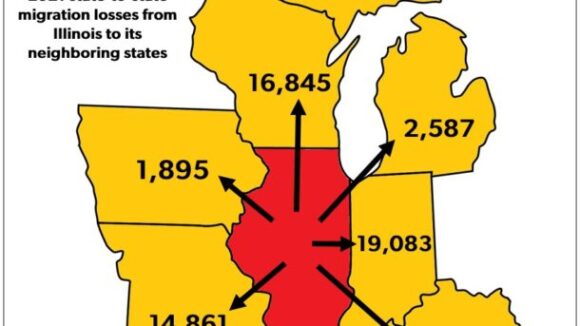
Virginia’s robust job and wage growth compares favorably with the sluggish performance of union-dominated states like Michigan, Illinois and Wisconsin. (more…)

Matt Mayer of the Buckeye Institute debunks the long-term economic growth without Right To Work freedom is sustainable. Mayer uses a Columbus Dispatch reporter Joe Hatlett column that featured Former Michigan Gov. Jennifer Granholm to expose the fact that corporate welfare and reduced regulations ignore the “proverbial elephant in the room weighing down” compulsory union states like Indiana, Ohio, Illinois,, and Michigan.

From Matt Mayer’s post:

“With Michigan bleeding jobs and tax revenues, Granholm said she followed the corporate playbook in her attempt to close a huge state budget deficit and make Michigan more competitive. ‘In listening to the business community, I cut takes [sic] 99 times, and I ended shrinking government more than any state in the nation. In my two terms, I cut more by far than any state in the nation. And yet, we still have the highest unemployment rate.

There was no correlation.’ Granholm conceded that streamlining business regulations and lowering taxes — Kasich’s economic recovery mantra — are helpful, but they aren’t a panacea…[l]abor costs, help with start-up costs and proximity to markets are other factors.”

Hallett and Governor Granholm fail to mention why streamlining regulations and lowering taxes aren’t helping the northern states (located within 50 percent of the U.S. population and with low start-up costs) compete against the southern and western states. Instead, Hallett ignores the obvious answer and pleads for an end to corporate pork (with which we enthusiastically agree).

The reason Michigan and Ohio can’t compete is that the southern and western states already have fewer regulations and lower taxes, so “catching up” with those states still leaves the proverbial elephant in the room weighing down the northern states. Plus, those states are also pushing for lower taxes and fewer regulations, so the northern states are perpetually behind them. The elephant, which Governor Granholm does hint at, is labor costs, or, more specifically, unionized labor costs (see: General Motors and the United Auto Workers).

As I noted in Six Principles for Fixing Ohio, “Of course, tax and regulatory burdens also impact a state’s economy. Although many of the forced unionization states have heavy tax burdens and many of the worker freedom states have light tax burdens, some heavily taxed worker freedom states (Idaho, Nevada, and Utah) had the strongest sustained job growth from 1990 to today.

Similarly, a few moderately taxed forced unionization states still had weak job growth (Indiana, Illinois, and Missouri). The combination of both a heavy tax burden and forced unionization is deadly when it comes to job growth, as 11 of the 15 worst performing states are ranked in the top 20 for high tax burdens.” If Ohio and the other states from Missouri to Maine want to truly compete with Texas, Georgia, and South Carolina, then those states need to enact laws that protect the rights of workers not to join a labor union to get a job. (more…)

Pay Your Own Way — Unconstitutional?

Big Labor union bosses in Illinois are fuming over a proposal that would require government workers to pay more toward their retirement. In fact, according to the head of the American Federation of State, County and Municipal Employees union, such a proposal — which is commonplace in the private sector — would violate the state’s constitution.

The arrogance of Big Labor never ceases to amaze. No wonder taxpayers, including private sector union members, have turned against the greed and entitlement mentality of government unions.

Americans overwhelming choose Right To Work freedom when they are given the choice. As Diana Furchtgott-Roth points out in her Real Clear Politics article, people prefer the choice to job or not a join a union:

The American people have been voting with their feet, the Census Bureau announced on Tuesday, leaving states with heavy union influence and choosing to live in “right to work” states with higher job growth where they cannot be forced to join a union as a condition of employment.

But the National Labor Relations Board, now dominated by Obama appointees, is deaf to the preferences of voting Americans. It wants to do everything in its administrative power to tilt the playing field towards unionization-even if it means higher unemployment and lost jobs.

As a result of geographic shifts in population uncovered by the 2010 Census, nine congressional seats will move to right-to-work states from forced unionization states. Some winners are Texas, Florida, Arizona, Georgia, and South Carolina, while losers include New York, Ohio, Michigan, Illinois, and New Jersey. Over the past 25 years job growth in right-to-work states has been over twice as high as in unionized states.

Change in Wisconsin

 Newly elected Wisconsin Governor Scott Walker is not backing down from a fight to protect taxpayers.  Walker has proposed reforming the state’s collective bargaining laws to protect taxpayers.  The Wall Street Journal takes note: 

Wisconsin Governor-elect Scott Walker has laid out an ambitious agenda, such as turning the department of commerce into a public-private partnership and lifting the cap on school vouchers. But his boldest idea may be rescinding the right of government employees to collectively bargain.

Mr. Walker floated the idea last week in response to union opposition to his modest proposal to require employees to contribute 5% of their pay to their pensions and to increase their health-care contributions to 12% from as low as 4% today. Even along the Left Coast most state workers contribute 10% of their salary to pensions. The Republican estimates that these changes would save the state $154 million in the first six months. Over two years they’d reduce the state’s $3.3 billion budget gap by nearly 20%.

The ability of public workers to form unions and bargain collectively is a phenomenon of the last century when state and local governments were relatively small. But it has proven to be a catastrophe for taxpayers, as public unions have used their political clout to negotiate rich deals on wages, pensions and health care. California governor-elect Jerry Brown greased the wheels for his state’s long fiscal decline when he allowed collective bargaining during his first stint in the statehouse in the 1970s.

Republican Governor Mitch Daniels of Indiana and then Governor Matt Blunt of Missouri rescinded collective bargaining by executive order in 2005, and the change made it easier to cut spending and restructure government services. In Wisconsin, the legislature would have to rewrite the Employment Labor Relations Act, but Republicans will control both the assembly and senate and have the political incentive to go along with Mr. Walker.Rescinding public collective bargaining rights restores a better negotiating balance between taxpayers and government employees who ostensibly work for them. Political officials are no longer on both sides of the bargaining table—representing taxpayers in negotiations with the unions while seeking union cash and endorsements when running for re-election. (more…)

Home-Care Providers Take State To Federal Court

National Right to Work Legal Defense Foundation Press Release:

News Release

Home-Care Providers Take Case Challenging State Unionization Scheme to Federal Appeals Court

Right to Work Foundation assists home-based personal care providers pushed into union ranks against their will

Chicago, IL (December 13, 2010) – A group of home-based personal care providers have filed a federal appeal against Governor Pat Quinn and union officials for their agreement to force Illinois’s home-based personal care providers under unwanted union boss control.

With free legal aid from National Right to Work Foundation attorneys, the personal care providers filed their appeal with the U.S. Court of Appeals for the Seventh Circuit after a district court judge ruled against them.

The appeal stems from a class-action lawsuit filed by the providers after Quinn signed an executive order designating 4,500 home-based personal care providers who care for individuals with disabilities as “public employees” and susceptible to unwanted union boss political “representation.”

Service Employees International Union (SEIU) and American Federation of State, County, and Municipal Employees (AFSCME) union bosses have been competing to force their monopoly control over the workers, even having out-of-state union organizers making “home visits” attempting to organize the providers through coercive “card check” unionization tactics. Not coincidentally, Quinn received the SEIU union bosses’ political endorsement and support during his closely-contested primary campaign earlier this year.

Quinn’s executive order mirrored one issued by disgraced former-Governor Rod Blagojevich, later codified, in which over 20,000 personal care providers were designated as state workers for the purpose of granting union bosses monopoly “representation” and forced dues privileges over them. Quinn’s executive order expanded Blagojevich’s to cover the additional 4,500 providers who were not included in the first executive order. (more…)