Union ‘Members’ Dues Money His Personal ATM’
IAFF Union Czar Faces Investigation For Misusing Millions in Workers’ Dues Mr. Schaitberger has long faced accusations of using workers’ forced-dues money for his personal benefit. ...

IAFF Union Czar Faces Investigation For Misusing Millions in Workers’ Dues Mr. Schaitberger has long faced accusations of using workers’ forced-dues money for his personal benefit. ...

Public-Safety Employees’ Freedom Under Fire With dyed-in-the-wool Big Labor House Speaker Nancy Pelosi once again calling the shots, IAFF union bosses may confidently anticipate they will not have much trouble getting their agenda through the House this year. Credit: Gage…
In Right to Work Virginia, Democrats have nominated former Clinton fundraiser Terry McAuliffe for governor. It is worth remembering that McAuliffe has a long history and relationship with the union bosses who are bankrolling his campaign in the hopes of…

(Source: January 2011 NRTWC Newsletter) Committee Defeats Police/Fire Monopoly-Bargaining Legislation With the long-anticipated conclusion of the 111th Congress a few weeks ago, National Right to Work Committee members and supporters achieved a major legislative victory that had seemed a near impossibility at the Congress's inception in 2009. Just before Christmas, Congress adjourned without having rubber-stamped Senate Majority Leader Harry Reid's (D-Nev.) so-called "Public Safety Employer-Employee Cooperation Act" (S.3991). This was government union bosses' "top legislative priority" in the 111th Congress, as International Firefighters (IAFF/AFL-CIO) union czar Harold Schaitberger admitted mournfully after the adjournment. Seasoned Capitol Hill observers had confidently predicted the Reid legislation would pass into law before the end of 2010, and with good reason. At the outset of the 2009-2010 Congress, the votes were there to pass the bill in both chambers of Congress. Furthermore, President Obama was publicly vowing to sign it as soon as it reached his desk.

Excerpt from NRTW President Mark Mix Op-Ed in the Washington Times (to read the full version, click here): Today, Big Government, not the private sector, is Big Labor's bread and butter. That's why union officials push relentlessly for higher taxes and bigger government and seem completely unconcerned that the policies they advocate will slash overall private-sector job growth in future years. Just three decades ago, less than a third of all employees subject to "exclusive" union bargaining worked for the government. Earlier this year, the U.S. Labor Department reported that for the first time ever, a majority of unionized workers across America are now government employees. The outsized power and privileges of government union bosses clearly are a major force behind the unsustainable growth of government payrolls. According to data furnished by respected labor economists Barry T. Hirsch and David A. Macpherson, nonunion government employment nationwide actually fell by 2 percent, but Big Labor-controlled government employment grew by nearly 4 percent from 2007 to 2009. Incredibly, nearly all Democrats and many Republicans on Capitol Hill appear eager to make matters even worse by rubber-stamping legislation (H.R. 413 and S. 3194) that would federally grant public-safety union officials monopoly bargaining privileges over state and local public employees nationwide.
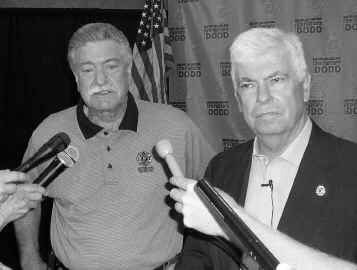
(Source: August 2010 NRTWC Newsletter) Public-Safety Forced Unionism Still High on Capitol Hill Agenda The American people do not support Big Labor's legislative scheme to establish a new federal mandate imposing union "exclusive representation" (monopoly bargaining) over state and local police, firefighters, and other public-safety employees nationwide. And powerful union-label politicians like U.S. House Speaker Nancy Pelosi (D-Calif.) and U.S. Senate Majority Leader Harry Reid (D-Nev.) know this public-safety scheme (H.R.413/S.3194) is unpopular. That's why they have repeatedly tried to sneak it through Congress. Most recently, in June, Ms. Pelosi and her top lieutenants cut a deal with AFL-CIO President Richard Trumka and other union bigwigs to attach H.R.413, the House version of the Police/Fire Monopoly-Bargaining Bill, to a massive spending bill that provides funding for U.S. troops. International Association of Firefighters (IAFF) union boss Harold Schaitberger openly admitted to helping concoct the scheme to tack H.R.413 on to H.R.4899, the Fiscal Year (FY) 2010 Supplemental Appropriations Act, in a June 30 message to officers of his union subsidiaries. Early last month, the National Right to Work Committee obtained a copy of Mr. Schaitberger's communication. Firefighters Union Chief 'Argued Strongly' For War Supplemental Strategy Mr. Schaitberger reported that he had "argued strongly" for attaching H.R.413 "to the War Supplemental funding proposal for our troops in Afghanistan." The backroom deal between House leaders and the union hierarchy allowed the public-safety forced-unionism measure to come to the floor so quickly that Right to Work members and their allies had virtually no time to mobilize for the vote.
Even Washington Post editors oppose forcing police officers and fire fighters into labor unions: Congress should let states handle their own labor relations ALL ACROSS America, state and local governments are struggling with recession-induced budget crises as revenue has…
Even Washington Post editors oppose forcing police officers and fire fighters into labor unions: Congress should let states handle their own labor relations ALL ACROSS America, state and local governments are struggling with recession-induced budget crises as revenue has…

Monopoly-Bargaining Mandate Would Bust Budgets Across Nation (Source: April 2010 NRTWC Newsletter) Over the course of the past few decades, public servants, especially state and local government employees, have become Big Labor's bread and butter. By 2009, union officials wielded monopoly-bargaining power over 7.5 million state and local employees, nearly 43% of all such employees nationwide, compared to just 8% of private-sector workers. Moreover, for many years now, Big Labor featherbedding and counterproductive work rules have sharply increased real taxpayer costs for compensation of state and local government employees. In fact, from 1998 to 2008 alone, taxpayers' aggregate real costs for compensation of state and local government employees soared at a rate nearly 50% faster than the total real growth of private-sector employee compensation! And now, incredibly, the Big Labor Congress is poised to sock it to taxpayers again. This spring, the U.S. House and Senate are on the verge of rubber-stamping a new federal mandate ensuring that public-sector union bosses get monopoly-bargaining privileges over additional hundreds of thousands of state and local public-safety employees. Kildee-Gregg Would Pave Way For Dragooning All State, Local Employees Into Unions This federal mandate (H.R.413 and S.1611), respectively introduced in the House and Senate by Big Labor Congressman Dale Kildee (D-Mich.) and Big Labor-appeasing Sen. Judd Gregg (R-N.H.), goes by an innocent-sounding moniker, the "Public Safety Employer-Employee Cooperation Act." But this label mocks the reality that the legislation would incite conflict between government agencies and employees and hurt taxpayers. H.R.413/S.1611 would institute a federal mandate foisting union "exclusive representation" (monopoly bargaining) on state and local police, firefighters, and other public-safety employees nationwide.