UAW Bosses use strike to hire UAW bosses’ sons

Real Monopoly Bargaining Power:  Two UAW Bosses Guilty of Extortion

Danny Douglas and Jay Campbell, have been sentenced to 18 months and 12 months plus one day, respectively, after being convicted of extortion. It seems the two former United Auto Workers bosses agreed to end an 87-day strike at a GM plant in Pontiac, MI back in 1997 – but only after General Motors agreed to hire Campbell’s son and the son of another UAW official for high-paying jobs they were evidently not qualified for.

Did the Obama Administration Negotiate the GM-UAW Deal?

Mickey Kaus picked up an interesting tidbit from a union newsletter:

Corporatism Watch: Blame the Proofreader! Was a representative of the Obama administration “literally sitting in the room” for recent UAW/GM negotiations—as a newsletter to members of a UAW local said.  Or was the union report just a “misprint, as an official of the local now claims? … P.S.: Does it matter? The  government owns 32% of GM, after all. Why shouldn’t it watch over its investment? I suppose there are two fears: 1) The Obama administration might order GM’s managers to give the UAW a break the union otherwise wouldn’t get, or 2) The Obama administration might try to facilitate any agreement–including perhaps one that includes concessions the UAW otherwise wouldn’t give–by promising to make it up to everyone involved by steering business or favorable government rulings their way or by simply bailing them all out again.  Both sorts of favoritism can be accomplished, however, whether government officials are “in the room” or merely get second-hand reports and make a few phone calls. It’s mainly a question of “optics.” …

But given the impossibility of real transparency–i.e., proving to the public that the administration isn’t playing favorites, directly or by remote control–optics are all the Obama administration’s got. …

Tagged with:
Posted in: Right to Work

Matt Mayer of the Buckeye Institute debunks the long-term economic growth without Right To Work freedom is sustainable. Mayer uses a Columbus Dispatch reporter Joe Hatlett column that featured Former Michigan Gov. Jennifer Granholm to expose the fact that corporate welfare and reduced regulations ignore the “proverbial elephant in the room weighing down” compulsory union states like Indiana, Ohio, Illinois,, and Michigan.

From Matt Mayer’s post:

“With Michigan bleeding jobs and tax revenues, Granholm said she followed the corporate playbook in her attempt to close a huge state budget deficit and make Michigan more competitive. ‘In listening to the business community, I cut takes [sic] 99 times, and I ended shrinking government more than any state in the nation. In my two terms, I cut more by far than any state in the nation. And yet, we still have the highest unemployment rate.

There was no correlation.’ Granholm conceded that streamlining business regulations and lowering taxes — Kasich’s economic recovery mantra — are helpful, but they aren’t a panacea…[l]abor costs, help with start-up costs and proximity to markets are other factors.”

Hallett and Governor Granholm fail to mention why streamlining regulations and lowering taxes aren’t helping the northern states (located within 50 percent of the U.S. population and with low start-up costs) compete against the southern and western states. Instead, Hallett ignores the obvious answer and pleads for an end to corporate pork (with which we enthusiastically agree).

The reason Michigan and Ohio can’t compete is that the southern and western states already have fewer regulations and lower taxes, so “catching up” with those states still leaves the proverbial elephant in the room weighing down the northern states. Plus, those states are also pushing for lower taxes and fewer regulations, so the northern states are perpetually behind them. The elephant, which Governor Granholm does hint at, is labor costs, or, more specifically, unionized labor costs (see: General Motors and the United Auto Workers).

As I noted in Six Principles for Fixing Ohio, “Of course, tax and regulatory burdens also impact a state’s economy. Although many of the forced unionization states have heavy tax burdens and many of the worker freedom states have light tax burdens, some heavily taxed worker freedom states (Idaho, Nevada, and Utah) had the strongest sustained job growth from 1990 to today.

Similarly, a few moderately taxed forced unionization states still had weak job growth (Indiana, Illinois, and Missouri). The combination of both a heavy tax burden and forced unionization is deadly when it comes to job growth, as 11 of the 15 worst performing states are ranked in the top 20 for high tax burdens.” If Ohio and the other states from Missouri to Maine want to truly compete with Texas, Georgia, and South Carolina, then those states need to enact laws that protect the rights of workers not to join a labor union to get a job. (more…)

(Source:  May 2010 Forced-Unionism Abuses Exposed)

Just last summer, the Obama Administration handed over $49.5 billion in federal taxpayers’ money to the Big Labor-controlled, money-hemorrhaging General Motors Corporation (GM). At the time, bankrupt GM was on the verge of being forced into liquidation. Its assets would then have been sold off.

The White House pitched this costly taxpayer-funded bailout as a bid to save American jobs. In reality, GM’s reported U.S. employment has shrunk by nearly 25%, down to 68,500, just since last year’s bailout, and is almost certain to continue falling. More than 80% of U.S. automotive manufacturing jobs are now in union-free firms, and these firms, not bailed-out GM and Chrysler, surely represent the future of domestic auto manufacturing employment.

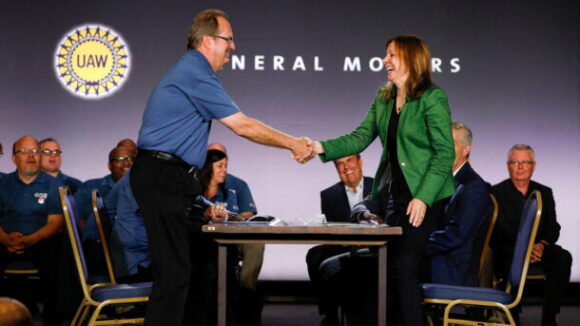
Rather than workers, the single greatest beneficiary of the GM bailout was the United Autoworkers (UAW) union hierarchy. Along with sympathetic Obama agents, union officials were effectively left in charge of the company. Given that the wasteful work rules that UAW bosses, wielding government-granted monopoly-bargaining power over employees, insisted on for decades were largely what drove the company into bankruptcy, they certainly didn’t deserve kid-gloves treatment. Yet that’s what they got. (more…)

GM and Union Boss Bailout Spin

General Motors is owned in part by the United Auto Workers. In an effort to help spin the bankruptcy and bailout, the Obama Administration recently made an outrageous claim declaring that the company had “repaid” its $6.7 billion loan from the government.  Malarky.

Fox News reports that the repayment was made by dipping further into the bailout money pot:

“The hype is not the reality,” Sen. Charles Grassley, R-Iowa, wrote in a column on FoxNews.com over the weekend. “It is far from clear how GM and the Obama administration could honestly say, much less trumpet in prime time television ads, that GM repaid its TARP (Troubled Asset Relief Program) loans in any meaningful way.”

Grassley wrote a letter last week to Treasury Secretary Timothy Geithner expressing his concerns and asking for more information about why the company was allowed to use bailout money to repay bailout money.

The $6.7 billion is also just a fraction of the $52 billion General Motors received in government aid. Grassley said lawmakers are being told government losses on GM are expected to exceed $30 billion. (more…)