Martin and Mix Expose Biden's latest example a pro-Big Labor radical US Labor Secretary: Julie Su
Talker Ed Martin and Mark Mix discuss dangers inherent in Biden's Julie Su Labor Secretary Appointment
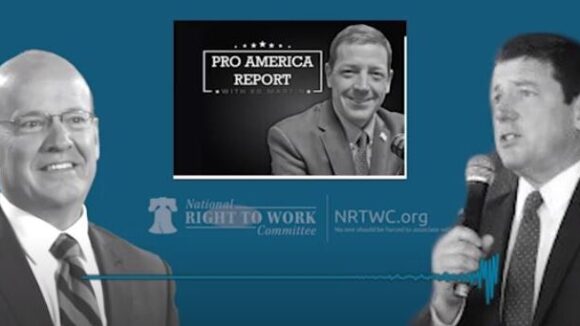
Talker Ed Martin and Mark Mix discuss dangers inherent in Biden's Julie Su Labor Secretary Appointment

Unions bosses push state legislatures for “labor history” courses to indoctrinate young students. Unions and their allies are trying to flex their muscle in state legislatures, pushing for labor history to be…

Meet President Obama’s man for the NLRB: That recess appointee, Richard Griffin, was former general counsel for the 400,000-member union of heavy equipment operators — a union tainted over the years by mob connections and…
Watch the latest video at video.foxnews.com Charity and volunteerism is a hallmark of American civics. But, if big labor has its way, volunteering to help others will go the way of the dinosaur. Volunteers are “eroding the number of…
Watch the latest video at video.foxnews.com Charity and volunteerism is a hallmark of American civics. But, if big labor has its way, volunteering to help others will go the way of the dinosaur. Volunteers are “eroding the number of…

The Wall Street Journal's Paul Gigot, Dan Henninger, James Freeman, Dorothy Rabinowitz, Kim Strassel and Collin Levy discuss the individual freedom and business opportunities that Indiana's Right To Work bills bring to the Hoosier state: Gigot: The first big labor fight of the year is taking shape in the Hoosier State. How Indiana's right-to-work push could change the political and economic landscape in the Midwest. Gov. Mitch Daniels: The idea that no worker should be forced to pay union dues as a condition of keeping a job is simple and just. But the benefits in new jobs would be large. A third or more of growing or relocating businesses will not consider a state that does not provide workers this protection. Gigot: He was reportedly booed by protesters in the statehouse hallways for those remarks in his annual State of the State Address this week, but Gov. Mitch Daniels is hoping to make Indiana the first state in more than a decade to approve right-to-work legislation. It would allow individual workers to decide if they want to join a union and ban contracts that require nonunion members to pay dues once their work site is organized. Republican leaders in the state have made it their top legislative priority this year, but Democrats and their union allies aren't giving up without a fight. So, Collin, we heard last year, after the brawl in Wisconsin, that somehow this was over for a union reform movement. What's--why is it happening in Indiana now? Levy: Well, I mean, I think it is a really interesting situation you see happening in Indiana, because Indiana's this sort of industrial state of the Midwest. And you have a particular situation now where Indiana is poised to achieve enormous competitive advantages over states in the Midwest like Michigan, like Illinois. These are high-taxed, unionized states. And Gov. Daniels has taken this moment to say, "You know, we've already made sort of some significant gains in terms of improving the business climate here. We saw what happened in Wisconsin. But, look, you know, we have an opportunity to lure an awful lot of businesses here if we can make it clear that workers can act as free agents," you know? Unions are portraying this as a radical change, but it's really just about worker freedom. Gigot: Kim, the nearest right-to-work state in the Midwest is Iowa. So how much economic benefit could there be here, really, when you get down to it, for Indiana? Strassel: It's huge. When Mitch Daniels talks about this, he is looking at the South. That is where the epicenter of most right-to-work states have been and where there has been a flood of manufacturers who have moved from the North to the South over recent decades to take advantage of those lower-cost, nonunionized states. And if Indiana could do this, it would be a sort of central pole for people to remain in the Midwest and locate and give an enormous advantage over competitors. Gigot: The last state to try to do this was New Hampshire, believe it or not, which had elected huge Republican legislative majorities in 2010. Tried to pass right-to-work. They did. It was vetoed by the Democratic governor. Indiana Republicans also have big majorities, and it looks like they are poised to do it. Henninger: And I hope they do. I mean, I think this is really almost a life-and-death issue for Indiana. Twenty percent of Indiana's workforce is in manufacturing. That's the highest percentage in the United States.
The Wall Street Journal's Paul Gigot, Dan Henninger, James Freeman, Dorothy Rabinowitz, Kim Strassel and Collin Levy discuss the individual freedom and business opportunities that Indiana's Right To Work bills bring to the Hoosier state: Gigot: The first big labor fight of the year is taking shape in the Hoosier State. How Indiana's right-to-work push could change the political and economic landscape in the Midwest. Gov. Mitch Daniels: The idea that no worker should be forced to pay union dues as a condition of keeping a job is simple and just. But the benefits in new jobs would be large. A third or more of growing or relocating businesses will not consider a state that does not provide workers this protection. Gigot: He was reportedly booed by protesters in the statehouse hallways for those remarks in his annual State of the State Address this week, but Gov. Mitch Daniels is hoping to make Indiana the first state in more than a decade to approve right-to-work legislation. It would allow individual workers to decide if they want to join a union and ban contracts that require nonunion members to pay dues once their work site is organized. Republican leaders in the state have made it their top legislative priority this year, but Democrats and their union allies aren't giving up without a fight. So, Collin, we heard last year, after the brawl in Wisconsin, that somehow this was over for a union reform movement. What's--why is it happening in Indiana now? Levy: Well, I mean, I think it is a really interesting situation you see happening in Indiana, because Indiana's this sort of industrial state of the Midwest. And you have a particular situation now where Indiana is poised to achieve enormous competitive advantages over states in the Midwest like Michigan, like Illinois. These are high-taxed, unionized states. And Gov. Daniels has taken this moment to say, "You know, we've already made sort of some significant gains in terms of improving the business climate here. We saw what happened in Wisconsin. But, look, you know, we have an opportunity to lure an awful lot of businesses here if we can make it clear that workers can act as free agents," you know? Unions are portraying this as a radical change, but it's really just about worker freedom. Gigot: Kim, the nearest right-to-work state in the Midwest is Iowa. So how much economic benefit could there be here, really, when you get down to it, for Indiana? Strassel: It's huge. When Mitch Daniels talks about this, he is looking at the South. That is where the epicenter of most right-to-work states have been and where there has been a flood of manufacturers who have moved from the North to the South over recent decades to take advantage of those lower-cost, nonunionized states. And if Indiana could do this, it would be a sort of central pole for people to remain in the Midwest and locate and give an enormous advantage over competitors. Gigot: The last state to try to do this was New Hampshire, believe it or not, which had elected huge Republican legislative majorities in 2010. Tried to pass right-to-work. They did. It was vetoed by the Democratic governor. Indiana Republicans also have big majorities, and it looks like they are poised to do it. Henninger: And I hope they do. I mean, I think this is really almost a life-and-death issue for Indiana. Twenty percent of Indiana's workforce is in manufacturing. That's the highest percentage in the United States.
A former National Labor Relations Board Chairman has described recent actions against Boeing for opening a production line in a Right to Work state as “unprecedented.” Boeing, to their credit is fighting back. “This claim is legally frivolous and…
A former National Labor Relations Board Chairman has described recent actions against Boeing for opening a production line in a Right to Work state as “unprecedented.” Boeing, to their credit is fighting back. “This claim is legally frivolous and…