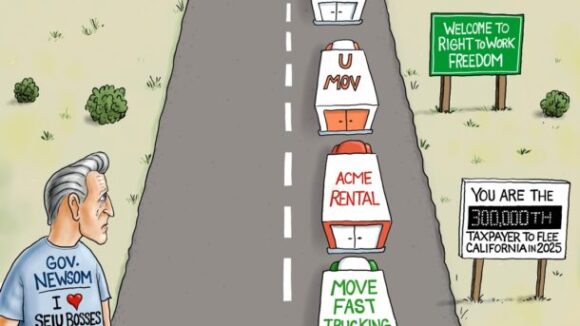
Boeing OKs Another Right To Work Facility

Right To Work Oklahoma City, OK will be home to a new Boeing facility according to the Tacoma News Tribune:

The company will use the 320,000-square-foot structure near Tinker Air Force Base as home to its B-1 bomber modification program and its C-130 avionics update program.

The company plans to move 500 jobs from Long Beach, Calif to the Oklahoma capital to staff those engineering programs.

The Oklahoma City expansion is the latest Boeing move to shift work from higher cost states…

Jobs continue to flee California.

Sign-Up For NRTWC’s Free Once-a-Day Update Summaries

Expect Big Labor Democrats in Washington, DC to be in full attack mode on Thursday during U.S. Rep. Darrell Issa’s House Oversight Committee hearing, “State And Municipal Debt: Tough Choices Ahead.”

Wisconsin Gov. Scott Walker is coming to Washington just after winning his multi-week battle with Big Labor that gave, among other things, state government employees the choice to pay a union or not. Gov. Walker’s and the WI Legislature’s action undid decades of compulsory unionism that forced all state government employees to handover money to unions or lose their job; essentially conscripting employees into the union. Many union bosses in Wisconsin are terrified that current forced-dues payers will opt out of the union. Walker is no stranger to union boss pressures, as mayor, he fought several battles with Big Labor.

National Right To Work President Mark Mix has personally fought hundreds of political battles and is currently engaged in several with Big Labor Bosses across the country. Since 1955, The National Right To Work Committee has been the prime architect that kept Big Labor at bay while clawing back freedom from compulsory unionism in states like Oklahoma and its passage of its Right To Work law that makes it illegal to force people to pay tributes to union bosses in order to keep or get a job.

No doubt, Big Labor operatives are busy creating talking points and questions for their Democrat congressional committee members. Or, perhaps they are planning another recent favorite tactic of Big Labor Democrats – fleeing to Illinois.

It is safe to say that having Walker and Mix at the same hearing is quite a turnaround from last year; Speaker Nancy Pelosi most certainly would have prevented their voices of freedom from being heard in any congressional hearing room.

For more on the hearing click here.

Change in Wisconsin

 Newly elected Wisconsin Governor Scott Walker is not backing down from a fight to protect taxpayers.  Walker has proposed reforming the state’s collective bargaining laws to protect taxpayers.  The Wall Street Journal takes note: 

Wisconsin Governor-elect Scott Walker has laid out an ambitious agenda, such as turning the department of commerce into a public-private partnership and lifting the cap on school vouchers. But his boldest idea may be rescinding the right of government employees to collectively bargain.

Mr. Walker floated the idea last week in response to union opposition to his modest proposal to require employees to contribute 5% of their pay to their pensions and to increase their health-care contributions to 12% from as low as 4% today. Even along the Left Coast most state workers contribute 10% of their salary to pensions. The Republican estimates that these changes would save the state $154 million in the first six months. Over two years they’d reduce the state’s $3.3 billion budget gap by nearly 20%.

The ability of public workers to form unions and bargain collectively is a phenomenon of the last century when state and local governments were relatively small. But it has proven to be a catastrophe for taxpayers, as public unions have used their political clout to negotiate rich deals on wages, pensions and health care. California governor-elect Jerry Brown greased the wheels for his state’s long fiscal decline when he allowed collective bargaining during his first stint in the statehouse in the 1970s.

Republican Governor Mitch Daniels of Indiana and then Governor Matt Blunt of Missouri rescinded collective bargaining by executive order in 2005, and the change made it easier to cut spending and restructure government services. In Wisconsin, the legislature would have to rewrite the Employment Labor Relations Act, but Republicans will control both the assembly and senate and have the political incentive to go along with Mr. Walker.Rescinding public collective bargaining rights restores a better negotiating balance between taxpayers and government employees who ostensibly work for them. Political officials are no longer on both sides of the bargaining table—representing taxpayers in negotiations with the unions while seeking union cash and endorsements when running for re-election. (more…)

Right To Work Helps Fuel the Jobs Engine

The publisher of Virginia Business, Bernie Niemeier, reminds readers among the natural advantages of states  such as  California, New York and Virginia it is often the “legal advantages”  ”like being the northernmost Right To Work state and having reasonable tort laws and a relatively low corporate income tax rate” that separates Virginia from the pack.

Excerpts from Niemeier’s  editorial, Job creation is fueled by existing business expansion:

Over the past few years, Virginia’s economic development news has been full of big marquee names: Volkswagen, Altria, Hilton, SAIC, Northrop Grumman and others. The commonwealth has held a winning hand in the high-profile game of attracting corporate headquarters from California, New York and other states.

Natural advantages such as the Port of Virginia, Dulles Airport and proximity to Washington, D.C., are important parts of our success. Legal advantages — like being the northernmost right-to-work state and having reasonable tort laws and a relatively low corporate income tax rate — also make Virginia an attractive place to do business.

When high-profile new business announcements are made, many take credit and rightfully so. Major out-of-state and international relocations involve the governor’s office, the Virginia Economic Development Partnership (VEDP), regional economic development alliances and local-level economic development offices.

We’ve been a little less than humble in continually reminding ourselves and others of our reputation as the best-managed state, one of the best states in which to do business and the most business-friendly state, among other accolades.

But perhaps Virginia’s existing businesses have been too humble in taking credit for the jobs their expansion and growth have created, especially during difficult economic times. In fact, existing businesses have led the commonwealth in job creation over the past several years. (more…)

Sherman’s Folly

Rep. Brad Sherman wants to outlaw Right to Work laws and the Investor’s Business Daily takes note:

Job Killer: A California congressman wants to eliminate right-to-work laws in 22 states where workers don’t have to join unions. If even-higher unemployment is his goal, he has the right idea.

Rep. Brad Sherman, a Democrat who represents a large part of Los Angeles’ San Fernando Valley, has introduced a bill that would repeal right-to-work statutes. These laws let workers employed at organized companies choose for themselves if they’re going to join the union or pay union dues. In the 28 states without right-to-work laws, workers are forced to join the union if their employer has been organized.

The depths to which lawmakers beholden to unions are willing to descend are almost bottomless, and labor is the second biggest contributor to Congressman Sherman’s campaign in the current cycle. He wants to keep that 100% AFL-CIO rating and seems to have no compunction about wrecking jobs elsewhere (California is not a right-to-work state) to keep his union support.

Sherman justifies the bill, H.R. 6384, on the free-rider argument. Right-to-work laws, he says, require unions to represent nondues-paying workers, and he wants those “exempt from paying” what he believes is “their fair share” to be forced into unions. (more…)

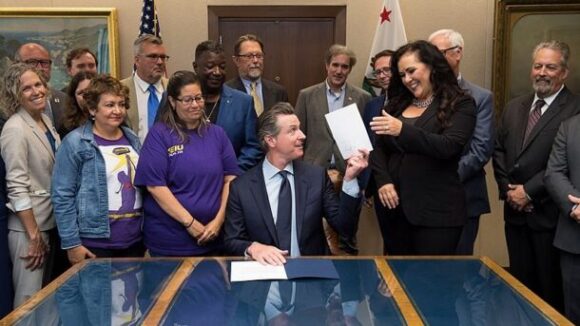
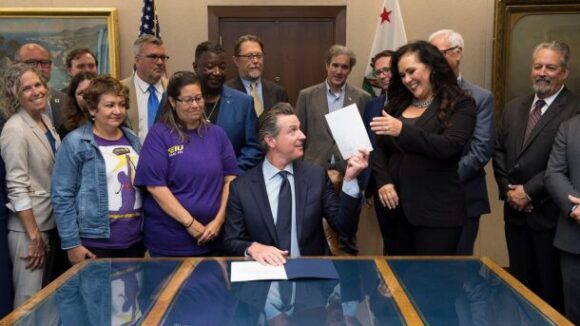
SEIU Endorses Pot Initiative

In California, voters will consider Proposition 19, a measure to legalize marijuana.  Supporters got a big boost this week as the SEIU, the state’s largest union, endorsed the measure.  Supporters of Proposition 19 hope the endosrement will bring with it the cash it so desperately needs to pass.

Of course, SEIU cash is nothing more than forced union dues money taken from workers.  Union boss Bill Lloyd wrote, “As you know, our primary objective in the 2010 election is targeting the top of the ticket. The lion’s share of our focus and resources are targeted at electing Jerry Brown as our next governor, but we look forward to joining you in any way we can to help pass Proposition 19.”

Whether it is to show solidarity to supporters of Jerry Brown or to support the tax that will be imposed on pot sales, this leading to more government spending, the SEIU is clearly behind the initiative.

Top Union Boss Huffs and Puffs, But Cannot Blow the Facts Down

(Source: June 2010 Forced-Unionism Abuses Exposed)

It doesn’t take a Sherlock Holmes or an Hercule Poirot to deduce that state policies promoting “exclusive” union bargaining and forced union dues and fees in the public sector have played a major role in driving multiple states to the verge of insolvency this year.  All it takes is the willingness to look at, and respect, the facts.

In 2009, according to respected labor economists Barry Hirsch and David Macpherson, 41% of public employees nationwide were subject to a contract negotiated by their employer with a union monopoly-bargaining agent.

However, in 22 states, none of which authorize forced union dues for government employees and most of which don’t authorize public-sector union monopoly bargaining, either, fewer than 30% of public servants were unionized.  Not one of these 22 low public-sector-unionization states was to be found on Business Insider’s list, published just last month, of the nine states “most likely to default.”  (more…)