Big Labor History Flashback

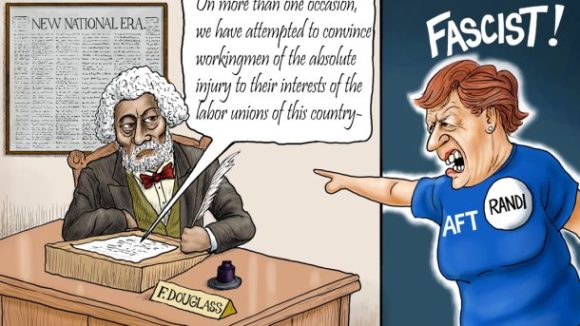
The American Federation of Teachers, AFL-CIO (AFT) which benefits dramatically from government employee forced dues at one time was opposed to representing both administrators and teachers.  From the New York Times, Aug 19, 1959 report from the AFT national convention held in Minneapolis, MN:

The American Federation of Teachers assailed the National Education Association today for what it termed “refusal to uphold” school desegregation decisions of the Supreme Court.

A Chosen Epithet “Company union” is an epithet the A. F. T. uses for the N. E. A., which represents school administrators as well as classroom teachers. The A. F. T. has 54,817 members, the N. E. A. about 700,000.

And, it opposed union financial disclosure known as the Landrum-Griffin Act.

It protested that the House passed Landrum-Griffin bill went far beyond the original intent of labor-management reform proposals by involving the Federal Government in the internal affairs of every union.


In New York state, a teacher who showed up late for class 101 times in a single school year and left early 47 times is still on the job.  Thanks to the monopoly bargaining power of the teacher’s union, she successfully fought the Department of Education’s attempts to fire her for 18 months and was able to return to the classroom.

The Albany Times Union reports that this teacher was not alone – She’s just one of hundreds of tenured teachers across the state who have kept their jobs despite poor performance and offenses that in many workplaces would be grounds for firing.

The story continues:

In fact, according to a state Education Department database obtained by the Times Union through a Freedom of Information request, it appears to be nearly impossible for a school district to fire a tenured public school teacher. The reason is twofold: job protection for unionized teachers is strong and the process for firing bad teachers — called a 3020-a hearing — is so drawn out and costly that most districts can’t afford it.

ecause it is so expensive and difficult, school districts outside of New York City are far less likely to even attempt to fire troubled educators although they enroll almost twice as many students, according to the comprehensive database of 2,087 3020-a hearings filed from 2006 to June 2011.

It’s cheaper to pay them a salary and stick them in a corner somewhere than go through the 3020-a process,” said Sharon Sweeney, executive director of the Four County School Boards Association, based in Wayne County. She said the 27 small districts she represents have only tried to fire about a dozen educators in 15 years, a number that does not reflect the reality of workplaces with thousands of employees.

Tagged with:
Posted in: Education, Public Employees, Teacher Unions

Some bills making their way through the Florida legislature are striking fear into the union bosses in Florida because it threatens big labor’s access to the wallets of teachers. One bill would would bar any public union from automatically deducting dues from members’ paychecks. Another would require unions to distribute annual reports on their financial activities. The abuse! The outrage! Making labor unions accountable to their employees and requiring them to collect their own dues money, rather than at taxpayer’s expense.

Government employee union woes are being felt from California to Maryland.  George W. Liebmann, executive director of the Calvert Institute for Policy Research Inc., lists several problems in Maryland in his Baltimore Sun op-ed:

Marylanders need instruction in how entrenched the state’s teachers’ unions are:

1. Eleven counties, including all the more populous ones, allow unions to collect “agency fees” from nonmembers, generating huge war chests. While in theory such fees are not supposed to be used for political purposes, a famous [NRTW] lawsuit in Washington state revealed that nearly 80 percent of “agency fees” are in fact so used.

2. The State Board of Education has only qualified authority over teacher certification. A special board, eight of whose 24 members are named by unions and six of whom are from teachers’ colleges, can only be over-ridden by a three-fourths vote of the State Board.

3. Under a law signed by Gov. Martin O’Malley last year, another special board, two of whose five members are named by unions, has the last word in resolving impasses in school labor negotiations.

4. Local union contracts impose maximums on the length of the school year, limitations originally derived from the needs of agricultural societies

5. Maryland’s charter school law is one of the few that binds charter school teachers to union contracts, and it provides few checks against refusal of applications by self-protective county boards.  Experimentation with “virtual schools” and distance learning is limited by a law binding employees to union contracts.

8. Contracts severely limit teacher attendance at PTA meetings, in some counties to two hours per year; and at post-school meetings, frequently to one hour a month. Evaluations and observations are severely limited; only a handful of teachers are ever found to be incompetent.

9. In all but three counties, third-party arbitrators, rather than the local board of education, are given the last word in grievance proceedings. There is a three-to-five step grievance procedure, making discipline of tenured teachers all but impossible. Out of a tenured force of more than 5,600, no more than two Baltimore City teachers were fired for cause, per year, between 1984 and 1990.

(more…)

Teacher Unions Must Collect their Own Dues

Governor Bob Riley speaks to a gathering of lawmakers and citizens before signing into law a series of sweeping anti-corruption reforms. Photo credit: Robin Cooper, Office of the Governor.

Alabama’s News 13: “A new era for state corruption reforms”

Governor Bob Riley signed what he called, some of the strongest anti-corruption laws in the country.

The legal departments at both unions are rechecking Senate Bill two.

Take a look at what some them will do: Ban the practice of secretly funneling money to political candidates, through political action committees, called “pac to pac transfers.” They also limit what lobbyists can spend on public officials and requires them to register and file disclosures.

Now a week old, Senate Bill 2 is being double and triple-checked by the legal departments of the state’s teacher unions. SB2 ends the practice of deducting union dues from paychecks. The unions say it’s political payback. Governor Riley calls it an end to financing political activity by special interest groups.

Jefferson County AFT President, Vi Parramore said, “I think hurrying an ethics bill through has been a disaster.”

Both unions agree, Hyche with the regional Alabama Education Association and Vi Parramore, President of the Jefferson County American Federation of Teachers, that senate bill two – ending the practice of deducting union dues from paychecks – was an attack on the AEA.

Parramore said, “But I think the bill is mean-spirited…”

Hyche said, “…the governor and Bradley Byrne hijacked the legislative process for political gain and for political payback.”

Where were these concerned union officials to be found when Harry Reid tried to ram through federally mandated monopoly bargaining on states during the Lame Duck?

Keeping the Gravy Train Rolling

After bailouts and billions of dollars worth of taxpayer handouts, the big public employee union bosses are spending freely to keep the train rolling.  From the Wall Street Journal:

The National Education Association, the largest U.S. teachers union, has independently spent more than $3.4 million that must be disclosed, including ad buys and direct-mail campaigns, for the key electioneering period from Sept. 1 to Oct. 14. The NEA spent $444,000 during the same stretch in 2006.

The American Federation of State, County and Municipal Employees has nearly matched its 2006 midterm outlays. It has spent $2.1 million on electioneering since the beginning of last month, according to FEC filings for two campaign committees associated with the union. That is just shy of the $2.2 million spent for that period in 2006.

Unions that represent government workers say this year’s election is crucial to them, given the uproar over public-sector budget issues. Officials elected this year will face tough choices on matters such as further fiscal assistance for the nation’s cash-strapped states and local governments.

The issue of campaign-related spending by public-sector unions has received more attention in recent years, as state and local governments struggle with pensions and other costs. Conservative critics and business leaders have said the unions largely seek to expand their influence at taxpayers’ expense. Some states have approved restrictions on political use of union dues, for example requiring unions to obtain permission from workers before spending dues on campaigns. (more…)

Coincidence? Billion $$$ Bailout – Revved Up Political Activity

Some dare call it a coincidence.

The same day that House Democrats return to Washington to hand state and teacher union bosses a $26 billion bailout, teacher’s union announces a “plan to rev up recess action to protect Democrats’ majority.”  See what $26 billion dollars can buy you?

A coincidence — surely not.

Don’t forget that out of the estimated 3.3 million public school teachers nationwide, teachers unions were expecting about 160,000 layoffs this year — just 4.8 percent of all teachers. 38.1 percent of those layoffs are centered in just three states: 9,000 in New Jersey, 16,000 in New York and 36,000 in California. About 57 percent of those 160,000 teachers are unionized as noted by the Heritage Foundation, with contributions to state and local unions averaging $300 per teacher.  Add another $162 per teacher to the National Education Association and $190 per teacher to the American Federation of Teachers, as reported by Education Next, and the Senate easily has voted to give a minimum $40 million to the public teachers unions’ political coffers.  That money will be mobilized into campaign ads, direct mail, phone banks, you name it, all to help elect Democrats.

When Big Labor plays with fire, taxpayers get burned

Empire State pupils enrolled in K-12 public schools fell by more than 121,000 over the last 10 years, schools added 14,746 teachers and 8,655 non-teaching professionals to their payrolls

 NRTW President Mark Mix commentary in the Washington Examiner:

July 8, 2010 Near midnight last Thursday, House Speaker Nancy Pelosi and her fellow forced unionism apologists in the U.S. House of Representatives disgracefully amended a “must-pass” war funding bill to include language that is designed to force police officers, firefighters, and Emergency Medical Technicians (EMTs) into “exclusive” union bargaining in every state in the country.

It doesn’t take a rocket scientist to figure out that policies expanding public sector monopoly unionism have played a major role in driving many states to the verge of insolvency. (more…)