National Right to Work Legal Defense Foundation News Release:

Wisconsin needs Right to Work law to protect workers from forced unionism abuses

Milwaukee, WI (March 16, 2011) – A U.S. Bank customer service and support employee has filed federal charges against a local union after AFSCME union officials illegally attempted to force him and his colleagues into full-dues-paying union membership.

Peter Quinones of Milwaukee filed the charges with the National Labor Relations Board (NLRB) on Tuesday with free legal assistance from National Right to Work Legal Defense Foundation staff attorneys.

After American Federation of State, County, and Municipal Employees (AFSCME) Local 777 union officials were granted monopoly bargaining privileges over approximately 300 U.S. Bank employees, Quinones sent a letter to union officials stating that he was exercising his right under National Right to Work Foundation-won Supreme Court precedent in Communication Workers v. Beck to refrain from full dues paying union membership.

Because Wisconsin is a forced unionism state, workers who refrain from formal union membership can still be forced to pay a certain amount of union dues, but cannot be compelled to pay the portion of union dues used for the union’s political, lobbying, and member-only activities.

Despite his letter, AFSCME Local 777 union officials continued to extract full union dues from his paycheck. After Quinones filed an unfair labor practice charge, union officials still refused to honor his request to exercise his legal rights.

Quinones’ latest charge seeks to prevent the AFSCME union hierarchy from requiring him to pay forced union fees by automatic deduction from his paycheck in violation of federal law.

“As we have seen in recent weeks, AFSCME union officials will stop at nothing to collect forced union dues from workers – whether they are in the public or private sector – to pay for their political activism,” said Patrick Semmens, National Right to Work Foundation legal information director. “Wisconsin’s workers desperately need Right to Work protections to protect them from the very union bosses that claim to care about workers’ rights while violating workers’ rights.”

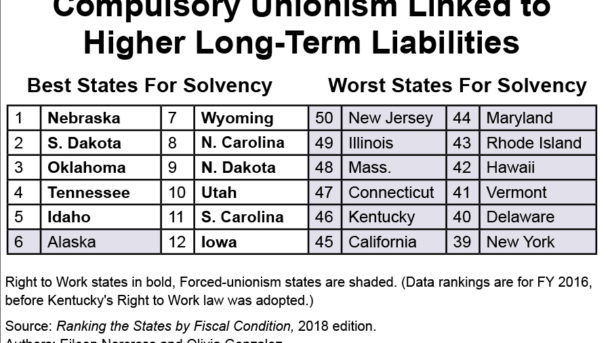
If enacted, a Wisconsin Right to Work law would end compulsory union dues by making union membership and dues payment strictly voluntary. Polls consistently show that 8 in 10 Americans support the Right to Work principle, that no worker should be compelled to join a union or pay union dues to get or keep a job. Twenty-two states have already passed Right to Work protections for their workers.

The National Right to Work Legal Defense Foundation is a nonprofit, charitable organization providing free legal aid to employees whose human or civil rights have been violated by compulsory unionism abuses. The Foundation, which can be contacted toll-free at 1-800-336-3600, is assisting thousands of employees in nearly 200 cases nationwide. Its web address is www.nrtw.org.
Share

Ohio Governor-elect John Kasich intends to overhaul current state employees’ collective bargaining rules (passed by Big Labor-financed state legislators and signed by a Big Labor-financed Governor) that he says allow unelected third parties to force the state of Ohio its counties and towns to raise taxes without any say by taxpayers.  Kasich also intends to dismantle federally imposed wage rules that drive up construction costs. 

A better idea would be to give all workers in Ohio the right to choose to pay or not pay union dues or fees, rather than being forced to pay dues and fees as a condition of employment.  Ohio needs a Right to Work law to protect all employees.

Reginald Fields of The Plain Dealer wrote:

COLUMBUS, Ohio — Public employees who go on strike over labor disputes should automatically lose their jobs, says Gov.-elect John Kasich.

“If they want to strike they should be fired,” Kasich said last week. “I really don’t favor the right to strike by any public employee. They’ve got good jobs, they’ve got high pay, they get good benefits, a great retirement. What are they striking for?”

Kasich has made it clear that dismantling Ohio’s collective bargaining law will be a top priority of his administration.

The 1983 collective bargaining law, which gives public employees a right to unionize, was implemented by a Democratic-controlled legislature and signed by Democratic Gov. Richard F. Celeste.

In particular, Kasich is going after binding arbitration rules … “You are forcing increased taxes on taxpayers with them having no say,” Kasich said.

The Middletown City Council recently tabled a resolution asking the Ohio General Assembly to revise the state’s collective bargaining law.

City Councilman Josh Laubach, who authored the resolution, said the city had to dip into reserves to pay police and fire costs this year and is expecting a $2.5 million increase in safety personnel in 2011 despite adding no new positions, according to the Middletown Journal.

The 1983 collective bargaining law, which gives public employees a right to unionize, was implemented by a Democratic-controlled legislature and signed by Democratic Gov. Richard F. Celeste. (more…)

Share

Home-Care Providers Take State To Federal Court

National Right to Work Legal Defense Foundation Press Release:

News Release

Home-Care Providers Take Case Challenging State Unionization Scheme to Federal Appeals Court

Right to Work Foundation assists home-based personal care providers pushed into union ranks against their will

Chicago, IL (December 13, 2010) – A group of home-based personal care providers have filed a federal appeal against Governor Pat Quinn and union officials for their agreement to force Illinois’s home-based personal care providers under unwanted union boss control.

With free legal aid from National Right to Work Foundation attorneys, the personal care providers filed their appeal with the U.S. Court of Appeals for the Seventh Circuit after a district court judge ruled against them.

The appeal stems from a class-action lawsuit filed by the providers after Quinn signed an executive order designating 4,500 home-based personal care providers who care for individuals with disabilities as “public employees” and susceptible to unwanted union boss political “representation.”

Service Employees International Union (SEIU) and American Federation of State, County, and Municipal Employees (AFSCME) union bosses have been competing to force their monopoly control over the workers, even having out-of-state union organizers making “home visits” attempting to organize the providers through coercive “card check” unionization tactics. Not coincidentally, Quinn received the SEIU union bosses’ political endorsement and support during his closely-contested primary campaign earlier this year.

Quinn’s executive order mirrored one issued by disgraced former-Governor Rod Blagojevich, later codified, in which over 20,000 personal care providers were designated as state workers for the purpose of granting union bosses monopoly “representation” and forced dues privileges over them. Quinn’s executive order expanded Blagojevich’s to cover the additional 4,500 providers who were not included in the first executive order. (more…)

Share

Mark Mix explains the insidious nature of forced-union dues spent by unions on political campaigns.  Big Labor, unlike any other contributor involved in the political process, forces people to pay fees and dues to it as a condition of getting or keeping a job.  Union bosses then use these forced-fees to promote the election of candidates that many who are forced to contribute oppose.

Share

Fox News Looks at Big Labor Political Spending


Neil Cavuto, Mike Huckabee, and National Right To Work President Mark Mix discuss President Obama’s double standard and impact of forced-dues in elections.

Share

Big Dog – “But We Don’t Like to Brag”

While the media is bashing outsider conservative groups and the Chamber of Commerce for spending on the elections, guess who are the real big spenders?  Big Labor.

The Wall Street Journal reports that while most attention has been given to the large spending initiatives by the U.S. Chamber of Commerce and other pro-Republican groups, the public-sector union American Federation of State, County and Municipal Employees, or AFSCME, is “now the biggest outside spender of the 2010 elections” and is spending $87.5 million to boost Democratic candidates. Said the head of AFSCME’s political operations: “We’re the big dog. But we don’t like to brag.”

This $87.5 million is mostly money spent from the general treasury of the union.  Just a small piece, perhaps 10%, is in the form of political action committee donations that are voluntary to union members.  The bulk of Big Labor’s dough comes from dues and fees money collected from workers who may or may not agree with the union bosses choices of issues and candidates. Unlike others who have to request their political contributions, the AFSCME and other unions are fueled by a never ending stream of mandatory forced dues money.

Share

Keeping the Gravy Train Rolling

After bailouts and billions of dollars worth of taxpayer handouts, the big public employee union bosses are spending freely to keep the train rolling.  From the Wall Street Journal:

The National Education Association, the largest U.S. teachers union, has independently spent more than $3.4 million that must be disclosed, including ad buys and direct-mail campaigns, for the key electioneering period from Sept. 1 to Oct. 14. The NEA spent $444,000 during the same stretch in 2006.

The American Federation of State, County and Municipal Employees has nearly matched its 2006 midterm outlays. It has spent $2.1 million on electioneering since the beginning of last month, according to FEC filings for two campaign committees associated with the union. That is just shy of the $2.2 million spent for that period in 2006.

Unions that represent government workers say this year’s election is crucial to them, given the uproar over public-sector budget issues. Officials elected this year will face tough choices on matters such as further fiscal assistance for the nation’s cash-strapped states and local governments.

The issue of campaign-related spending by public-sector unions has received more attention in recent years, as state and local governments struggle with pensions and other costs. Conservative critics and business leaders have said the unions largely seek to expand their influence at taxpayers’ expense. Some states have approved restrictions on political use of union dues, for example requiring unions to obtain permission from workers before spending dues on campaigns. (more…)

Share