Pro-Forced Dues Politicians Will Feel the Heat
National Right to Work Committee members and supporters across the country are fighting back through their active participation in the federal Committee Survey 2026 citizen mobilization program.
Bill Would Herd Now-Independent ‘First Responders’ Into Unions
U.S. Senate Majority Leader Harry Reid (D-Nev.) has sent out an unmistakable signal that he is dead set on pushing through a bill that would undermine state Right to Work laws and soak state and local taxpayers for billions of dollars in additional goverment costs.
 On April 12, Mr. Reid reintroduced as S.3194 the Police/Fire Monopoly-Bargaining Bill, which was already pending in the Senate Health, Education, Labor and Pensions (HELP) Committee as S.1611.
Mr. Reid’s clear purpose in carrying out this tactical maneuver was to make it possible for him to bring up this federal government union power grab for a Senate floor vote at any time, with as little as 48 hours public notice and with no HELP Committee action whatsoever in advance.
Harry Reid and his cohorts cynically mislabel their legislation, also introduced in the U.S. House as H.R.413 by union-label Congressman Dale Kildee (D-Mich.), as the “Public Safety Employer-Employee Cooperation Act.”
States’ Bitter Experiences Illustrate Dangers of Harry Reid’s Scheme
But that moniker has nothing to do with reality. S.3194/H.R.413 would institute a federal mandate foisting union “exclusive representation” (monopoly bargaining) on state and local police, firefighters, and other public-safety employees nationwide.
Reid-Kildee would force countless policemen, firefighters and EMT’s to accept as their monopoly-bargaining agent a union they never asked for or voted for, and want nothing to do with.
It would also constitute a major step towards Big Labor’s decades-old goal of enacting a federal law that foists union monopoly bargaining on front-line state and local employees of all types across America.
“In recent years, the expansion of public-sector union bosses’ monopoly-bargaining empire has become the top challenge to the prosperity of America’s private sector,” said National Right to Work Committee President Mark Mix.
“Consequently, the states in which government union bosses are relatively less powerful are our nation’s growth engine.”
According to labor economists Barry Hirsch and David Macpherson, as of 2004 fewer than one in four public-sector workers were unionized in 16 states. That same year, more than half of public-sector employees were unionized in 15 states.
From 2004 through 2009, the aggregate real personal income for the 16 states where government union bosses wielded the least power grew by 11.0%, an increase nearly two-and-a-half times as great as the total real income growth for the 15 states with the most public-sector monopoly bargaining.
And real income growth for the lowest union-monopoly states was greater by two-thirds than the national average.
Reid-Kildee Would ‘Replicate California’s Disaster Nationally’
Mr. Mix commented:
“This spring, incredibly, the U.S. Congress is poised to pass, and President Barack Obama is vowing to sign, legislation designed to help government union bigwigs seize monopoly-bargaining control over majorities of public employees in all 50 states.
“To get an idea of where Reid-Kildee could take America, you need only look at California, where nearly 60% of public employees are unionized (compared to 41% nationwide) and government union bosses have for years gotten practically everything they wanted.
“Today, Californians fork over a higher share of their incomes in state and local taxes than residents of all but five other states, but still face unfunded public-employee pension liabilities of as much as $500 billion. Meanwhile, overall income growth in the once-Golden State has fallen well below the national average in recent years.
“Does Congress really want to replicate California’s disaster nationally?”
Reid-Kildee would rewrite the public-sector labor laws of the vast majority of the 50 states to make them more pro-forced unionism.
In states that haven’t caved in to Big Labor demands for monopoly bargaining, Reid-Kildee would federally impose it, denying localities the option to refuse to grant a single union the power to speak for all front-line employees, including those who don’t want to join.
And in most states that already authorize public-safety union monopoly bargaining, S.3194/H.R.413 would widen its scope.
Right to Work States Would Likely Lose Key Edge They’ve Had Up to Now
“Employees and businesses in the 22 states with Right to Work laws, which prohibit the firing of employees for refusal to join or pay dues to an unwanted union, would lose a key advantage they’ve had up to now,” noted Mr. Mix.
“As Ohio University’s Richard Vedder, a widely recognized expert in labor economics, pointed out in a recent scholarly article, one important reason Right to Work states typically enjoy superior job and income growth is that a far smaller share of their employees are under union monopoly-bargaining control.
“But Reid-Kildee would facilitate the rapid spread of government union monopoly bargaining in states, overwhelmingly Right to Work states, where it has up to now been rare.
“While this federal scheme does not directly authorize forced dues in states where they are now prohibited, it obviously would reduce the relative attractiveness of the business climates of Right to Work states like Virginia, North Carolina, and Texas.
“Politicians who claim otherwise are either misinformed, or simply lying.”
“Right to Work supporters face an uphill battle against S.3194/H.R.413,” Mr. Mix acknowledged. “In the Big Labor-dominated House, the most we can do is slow the legislation down to buy time. And President Obama has publicly promised Big Labor he will sign the bill into law if he gets a chance.
“Our only chance of victory is in the Senate. That’s why, right now, Right to Work members and supporters are doing everything they can to mobilize 41 senators to sustain an extended debate and keep S.3194 from coming up for a final vote for as long as necessary.”

National Right to Work Committee members and supporters across the country are fighting back through their active participation in the federal Committee Survey 2026 citizen mobilization program.
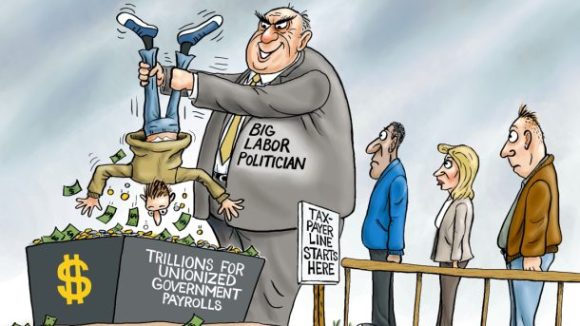
From 2015 to 2025, state and local governments’ collective spending soared by 62% (26 percentage points above the CPI), reaching nearly $4.4 trillion a year. Yet Big Labor propagandists insist government is being “starved”!

In 2014, with Right to Work attorneys’ help, Pam Harris and other home caregivers terminated schemes mandating union dues payment as a condition of receiving Medicaid reimbursements.