Pro-Forced Dues Politicians Will Feel the Heat
National Right to Work Committee members and supporters across the country are fighting back through their active participation in the federal Committee Survey 2026 citizen mobilization program.

From the Heritage Foundation an endorsement of Right to Work Freedoms for Michigan:
Did you know that there are no Volkswagen manufacturing plants in the Detroit area? Or Mercedes-Benz? Or Kia? Or Hyundai? Or BMW, for that matter?
Apart from having their cars assembled in Michigan, it turns out that those three companies have something else in common: the United Auto Workers union (UAW). It also turns out that every other car manufacturer has something in common, too: not wanting the UAW to do to them what it did to the Big Three.
Today, President Obama will address the UAW, and he should receive a rousing welcome. After all, his terms of the auto bailout richly rewarded his union allies at the expense of non-union employees and private investors, giving them, among other prizes, a very large stake of ownership in Chrysler. And together, they stand adamantly opposed to “right-to-work” laws that would empower the nation’s unemployed to find economic security with a non-union job.
They claim they want to protect “the American auto industry,” but this is not about “American cars.” The controlling interest of Chrysler is Italy-based Fiat and previously was Germany’s Daimler-Benz between 1997 and 2008. This is simply about protecting union fortunes.
Chrysler can hire actors in Louisiana to play the part of Detroit workers, and it can produce cinematically brilliant television ads. But wouldn’t Detroiters have more pride in a job than a commercial? Chrysler and the UAW must drop its opposition to Michigan’s right-to-work legislation if it wants to pretend it cares.
Right-to-work legislation protects employees from being fired for not paying union dues. Without that protection, workers are forced to support a union financially even if they’d rather spend their hard earned dollars at home, if the union contract harms them, or if they’re opposed to the union’s agenda. And if they don’t, they lose their jobs. Obviously, when given the freedom of choice, many workers choose not to unionize.Twenty-three states have right-to-work laws. But in Michigan, the powerful unions are preventing this job-creating measure from succeeding. And it is costing the state’s workers dearly.
As Heritage labor expert James Sherk recently noted: “Union organizing activity drops in half after a state becomes right-to-work. This attracts investment. Businesses want to know that, if they treat their workers well, unions will leave them alone. Right-to-work makes that more likely and businesses notice…It was no accident that Boeing built its new 787 assembly line in right-to-work South Carolina.”
As a result, manufacturing employment is over 30 percent higher in right-to-work states. Since 1990, the majority of new manufacturing plants by foreign automakers have been built in southern right-to-work states like Alabama, Georgia, South Carolina and Tennessee.
And while unions may offer their members certain benefits that are desirable, if not unsustainable, what they don’t offer is job security. Unlike in efficient, non-unionized manufacturing operations, unionized manufacturers are often forced into rounds of layoffs. There are about as many non-union manufacturing jobs today as in the late 1970s. During that time three-quarters of unionized manufacturing jobs have disappeared.
So when Chrysler started running ads during the past two Super Bowls touting itself as a savior of Detroit, as its beacon of hope, it was perplexing.
Chrysler employs a little over 4,000 employees in the city of Detroit, with 1,100 of these jobs recently “added,” as Chrysler would say. In reality, these were previously-downsized jobs restored.
By contrast, according to Kia, more than 10,000 jobs were created by the opening of its plant in West Point, Ga., in 2009, and it’s still expanding. The Mercedes-Benz plant in Tuscaloosa, Ala., has 4,000 line workers. Volkswagen and Hyundai both built plants in the last ten years that employ 2,000 workers. And the list goes on.
UAW-owned Chrysler’s opposition to right-to-work discouraged these auto manufacturing jobs from being created in Detroit, [and] UAW president Bob King is leading an effort to amend the Michigan constitution to permanently block right-to-work laws.
If you think it’s too late for Detroit, think again. Indiana recently passed right-to-work legislation, and according to the Detroit News, Caterpillar almost immediately shuttered a plant in Ontario, Canada, (where coincidentally it was locked in a labor dispute with a union) and announced a new plant in Indiana. Caterpillar also recently scrapped plans to build a plant employing 1,400 people in heavily-unionized Illinois citing the “business climate” and rumors are it will instead build that plant in right-to-work North Carolina.
We cannot continue to repeat mistakes and continue to offer Detroiters the same broken policies that turned a shining city into a busted mess. If the city ultimately fails, it will be a great symbol of the liberal philosophy of managing decline through dependency. If Detroit succeeds, it will be because its citizens were offered more choices, more freedom, more jobs, and more economic opportunity.

National Right to Work Committee members and supporters across the country are fighting back through their active participation in the federal Committee Survey 2026 citizen mobilization program.
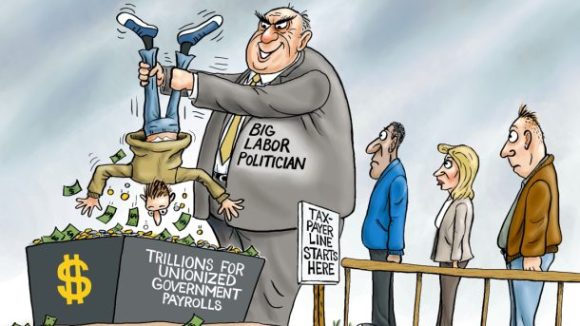
From 2015 to 2025, state and local governments’ collective spending soared by 62% (26 percentage points above the CPI), reaching nearly $4.4 trillion a year. Yet Big Labor propagandists insist government is being “starved”!

In 2014, with Right to Work attorneys’ help, Pam Harris and other home caregivers terminated schemes mandating union dues payment as a condition of receiving Medicaid reimbursements.