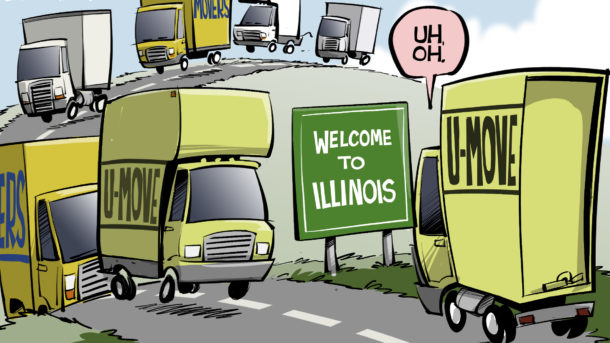
Illinois Gov. Pat Quinn (D-Big Labor) is trying to assure his state that Indiana’s decision to give worker’s Right to Work protection will have no impact on his state. Quinn said major companies are “thriving” in forced unionized Illinois. But reality tells a different story.

The News Gazette reported in January Jimmy Johns corporate headquarters is just one of many companies looking to leave the state for its anti-business and anti-worker policies:

Jimmy John Liautaud told The News-Gazette on Tuesday that he is angry about the moves, which boosted the individual income tax from 3 percent to 5 percent and the corporate income tax from 7.3 percent to 9.5 percent. The founder of Jimmy John’s said he has applied for Florida residency and may recommend that his corporate headquarters move out-of-state as a result of the Illinois tax increases enacted last week.

Stateline News also reported that Quinn’s tax hikes have governors in Wisconsin, Texas and even in New Jersey courting businesses from the Land of Lincoln. Indiana Gov. Mitch Daniels, who know has the Right to Work arrow in his quiver to court businesses to his state, has compared Illinois to “living next door to the Simpsons.”

Share

IL Gov. Quinn’s Big Labor proclamations chasing jobs away

After declaring that Illinois’ pro-Big Labor policies were keeping jobs in the state, Gov. Quinn (D) awoke to find that one of the state’s biggest employers, Caterpillar, would not be opening any plants in the Land of Lincoln.

The Journal Star reports:

Caterpillar, Inc. will not be building its new North American plant anywhere in the state of Illinois, officials with the company told local leaders Tuesday, with part of the reason being continued concerns about the business climate in the state.

The company will instead focus on a location closer to its division headquarters in Cary, N.C., Peoria County officials were told in an email sent to them shortly after the close of business and later obtained by the Journal Star. The plant stood to bring with it from Japan roughly 1,000 jobs manufacturing track-type tractors and mini hydraulic excavators.

Peoria County had submitted a regional proposal for the facility at the end of last year, and the Galesburg area also had a proposal on the table for the manufacturer. Peoria’s proposal reportedly included economic incentives as well as a promise of a legislative effort to establish a tax increment financing district to benefit the company.

North Carolina, of course, is a Right to Work state.

Share

The Greece Next Door to Wisconsin

It is worth remembering that Illinois has become the belly of the beast when it comes to pleasing the union bosses at expense of the taxpayer.  Even after raising taxes at the demand of union activists, the state is still suffering through an economic crisis.  This is the point that Wisconsin Gov. Scott Walker has been making — we can’t balance state budgets without reforming the power of the union bosses.  The Wall Street Journal notices the difference between Illinois and Wisconsin in a recent Op-Ed:

Run up spending and debt, raise taxes in the naming of balancing the budget, but then watch as deficits rise and your credit-rating falls anyway. That’s been the sad pattern in Europe, and now it’s hitting that mecca of tax-and-spend government known as Illinois.

Though too few noticed, this month Moody’s downgraded Illinois state debt to A2 from A1, the lowest among the 50 states. This wasn’t supposed to happen. Only a year ago, Governor Pat Quinn and his fellow Democrats raised individual income taxes by 67% and the corporate tax rate by 46%. They did it to raise $7 billion in revenue, as the Governor put it, to “get Illinois back on fiscal sound footing” and improve the state’s credit rating.

It’s worth contrasting this grim picture with that of Wisconsin north of the border. Last winter Madison was occupied by thousands of union protesters trying to bully legislators to defeat Republican Governor Scott Walker’s plan. The reforms passed anyway.

In contrast to the Illinois downgrade, Moody’s has praised Mr. Walker’s budget as “credit positive for Wisconsin,” adding that the money-saving reforms bring “the state’s finances closer to a structural budgetary balance.” As a result, Wisconsin jumped in Chief Executive magazine’s 2011 ranking of each state’s business climate—moving to 17th from 41st. Illinois dropped to 48th from 45th as ranked by the nation’s top CEOs. (more…)

Share

Minnesota Governor Mark Dayton, like former governors Gray Davis (CA), Rod Blagojevich (IL), and Jennifer Granholm (MI) to name a few, knows how to payback the SEIU union bosses — they all indentured parents and family members who take care of relatives to Big Labor.  It is a shameless act of pure political power compelling people who are not even employees of the state to be required to pay union dues and fees.  In Michigan,  Governor Rick Snyder ended Granholm’s SEIU payback scheme.  But, in other states like Minnesota, parents and family members have not been so fortunate.  That is why the National Right To Work Legal Defense is taking the case in an effort to expose the scheme and have the court system eventually rule against everyone of these schemes. Legal schemes that were in a large part a brainchild of Obama’s former NLRB member Craig Becker.

From The StarTribune article by Jim Ragsdale and Paul  Walsh:

Opponents of the drive to unionize in-home child care providers have filed a second suit aimed at blocking a union vote.

A group of 12 child-care providers, aided by the National Right to Work Legal Defense Foundation, filed suit Thursday in U.S. District Court in Minneapolis against Gov. Mark Dayton’s executive order authorizing a union election. The group argues that the order is unconstitutional because it could ultimately require all providers to be represented by the union, whether they want to or not.

The federal complaint says that if either or both unions win the elections in their geographic areas, the union would become the “exclusive” representative of all providers. It said the providers who filed the suit do not want to associate with either union “in any way” and “wish to retain their individual right to choose with whom they associate to lobby the state.”

“In the order, the state is going to designate a representative of these providers for the purposes of petitioning the state,” said William Messenger, an attorney for the foundation, based in Springfield, Va. “It infringes on the freedom of association — the First Amendment protects to right to associate or not associate.”

After an organizing drive by the Service Employees International Union and the American Federation of State, County and Municipal Employees, Dayton issued an order setting a union election for those providers who care for children with state subsidies — about 4,300 of the state’s 11,000 licensed in-home providers.

The foundation is focused on fighting what it considers “compulsory unionism,” such as workplaces where employees are required to be members. It is providing legal work on the lawsuit for free, Messenger said.

From the related National Right To Work Legal Defense Foundation press release: (more…)

Share

The Wall Street Journal’s Paul Gigot, Dan Henninger, James Freeman, Dorothy Rabinowitz, Kim Strassel and Collin Levy discuss the individual freedom and business opportunities that Indiana’s Right To Work bills bring to the Hoosier state:

Gigot:  The first big labor fight of the year is taking shape in the Hoosier State. How Indiana’s right-to-work push could change the political and economic landscape in the Midwest.

Gov. Mitch Daniels: The idea that no worker should be forced to pay union dues as a condition of keeping a job is simple and just. But the benefits in new jobs would be large. A third or more of growing or relocating businesses will not consider a state that does not provide workers this protection.

Gigot: He was reportedly booed by protesters in the statehouse hallways for those remarks in his annual State of the State Address this week, but Gov. Mitch Daniels is hoping to make Indiana the first state in more than a decade to approve right-to-work legislation. It would allow individual workers to decide if they want to join a union and ban contracts that require nonunion members to pay dues once their work site is organized. Republican leaders in the state have made it their top legislative priority this year, but Democrats and their union allies aren’t giving up without a fight.

So, Collin, we heard last year, after the brawl in Wisconsin, that somehow this was over for a union reform movement. What’s–why is it happening in Indiana now?

Levy: Well, I mean, I think it is a really interesting situation you see happening in Indiana, because Indiana’s this sort of industrial state of the Midwest. And you have a particular situation now where Indiana is poised to achieve enormous competitive advantages over states in the Midwest like Michigan, like Illinois. These are high-taxed, unionized states. And Gov. Daniels has taken this moment to say, “You know, we’ve already made sort of some significant gains in terms of improving the business climate here. We saw what happened in Wisconsin. But, look, you know, we have an opportunity to lure an awful lot of businesses here if we can make it clear that workers can act as free agents,” you know? Unions are portraying this as a radical change, but it’s really just about worker freedom.

Gigot: Kim, the nearest right-to-work state in the Midwest is Iowa. So how much economic benefit could there be here, really, when you get down to it, for Indiana?

Strassel: It’s huge. When Mitch Daniels talks about this, he is looking at the South. That is where the epicenter of most right-to-work states have been and where there has been a flood of manufacturers who have moved from the North to the South over recent decades to take advantage of those lower-cost, nonunionized states. And if Indiana could do this, it would be a sort of central pole for people to remain in the Midwest and locate and give an enormous advantage over competitors.

Gigot: The last state to try to do this was New Hampshire, believe it or not, which had elected huge Republican legislative majorities in 2010. Tried to pass right-to-work. They did. It was vetoed by the Democratic governor. Indiana Republicans also have big majorities, and it looks like they are poised to do it.

Henninger: And I hope they do. I mean, I think this is really almost a life-and-death issue for Indiana. Twenty percent of Indiana’s workforce is in manufacturing. That’s the highest percentage in the United States. (more…)

Share

Matt Mayer of the Buckeye Institute debunks the long-term economic growth without Right To Work freedom is sustainable. Mayer uses a Columbus Dispatch reporter Joe Hatlett column that featured Former Michigan Gov. Jennifer Granholm to expose the fact that corporate welfare and reduced regulations ignore the “proverbial elephant in the room weighing down” compulsory union states like Indiana, Ohio, Illinois,, and Michigan.

From Matt Mayer’s post:

“With Michigan bleeding jobs and tax revenues, Granholm said she followed the corporate playbook in her attempt to close a huge state budget deficit and make Michigan more competitive. ‘In listening to the business community, I cut takes [sic] 99 times, and I ended shrinking government more than any state in the nation. In my two terms, I cut more by far than any state in the nation. And yet, we still have the highest unemployment rate.

There was no correlation.’ Granholm conceded that streamlining business regulations and lowering taxes — Kasich’s economic recovery mantra — are helpful, but they aren’t a panacea…[l]abor costs, help with start-up costs and proximity to markets are other factors.”

Hallett and Governor Granholm fail to mention why streamlining regulations and lowering taxes aren’t helping the northern states (located within 50 percent of the U.S. population and with low start-up costs) compete against the southern and western states. Instead, Hallett ignores the obvious answer and pleads for an end to corporate pork (with which we enthusiastically agree).

The reason Michigan and Ohio can’t compete is that the southern and western states already have fewer regulations and lower taxes, so “catching up” with those states still leaves the proverbial elephant in the room weighing down the northern states. Plus, those states are also pushing for lower taxes and fewer regulations, so the northern states are perpetually behind them. The elephant, which Governor Granholm does hint at, is labor costs, or, more specifically, unionized labor costs (see: General Motors and the United Auto Workers).

As I noted in Six Principles for Fixing Ohio, “Of course, tax and regulatory burdens also impact a state’s economy. Although many of the forced unionization states have heavy tax burdens and many of the worker freedom states have light tax burdens, some heavily taxed worker freedom states (Idaho, Nevada, and Utah) had the strongest sustained job growth from 1990 to today.

Similarly, a few moderately taxed forced unionization states still had weak job growth (Indiana, Illinois, and Missouri). The combination of both a heavy tax burden and forced unionization is deadly when it comes to job growth, as 11 of the 15 worst performing states are ranked in the top 20 for high tax burdens.” If Ohio and the other states from Missouri to Maine want to truly compete with Texas, Georgia, and South Carolina, then those states need to enact laws that protect the rights of workers not to join a labor union to get a job. (more…)

Share

80% of Union Members Agree, Right To Work is Best Policy


When asked, workers choose freedom, even union workers. In Frank Luntz’ recent poll, 80% of union members chose the Right To Work which allows individuals to freely choose whether or not to belong or pay fees to union.

Here is the question Luntz’ pollsters asked union members across the country and the results are above:

Please tell me whether you strongly agree, somewhat agree, somewhat disagree or strongly disagree with the following statement: “Workers should have the right to decide whether to join a union. They should never be forced or coerced to join or pay dues to a union as a condition of employment.”

For the complete Frank Luntz – National Right To Work Legal Defense Foundation 2010 Union Member Survey click here.

Share

Home-Care Providers Take State To Federal Court

National Right to Work Legal Defense Foundation Press Release:

News Release

Home-Care Providers Take Case Challenging State Unionization Scheme to Federal Appeals Court

Right to Work Foundation assists home-based personal care providers pushed into union ranks against their will

Chicago, IL (December 13, 2010) – A group of home-based personal care providers have filed a federal appeal against Governor Pat Quinn and union officials for their agreement to force Illinois’s home-based personal care providers under unwanted union boss control.

With free legal aid from National Right to Work Foundation attorneys, the personal care providers filed their appeal with the U.S. Court of Appeals for the Seventh Circuit after a district court judge ruled against them.

The appeal stems from a class-action lawsuit filed by the providers after Quinn signed an executive order designating 4,500 home-based personal care providers who care for individuals with disabilities as “public employees” and susceptible to unwanted union boss political “representation.”

Service Employees International Union (SEIU) and American Federation of State, County, and Municipal Employees (AFSCME) union bosses have been competing to force their monopoly control over the workers, even having out-of-state union organizers making “home visits” attempting to organize the providers through coercive “card check” unionization tactics. Not coincidentally, Quinn received the SEIU union bosses’ political endorsement and support during his closely-contested primary campaign earlier this year.

Quinn’s executive order mirrored one issued by disgraced former-Governor Rod Blagojevich, later codified, in which over 20,000 personal care providers were designated as state workers for the purpose of granting union bosses monopoly “representation” and forced dues privileges over them. Quinn’s executive order expanded Blagojevich’s to cover the additional 4,500 providers who were not included in the first executive order. (more…)

Share