Port Crane Operators’ Jobs in Jeopardy
To top ILA bosses’ fury, union-free state employees do a share of the work at ports in three Right to Work states. But thanks to Biden NLRB appointees, those workers’ jobs may soon be scuttled!
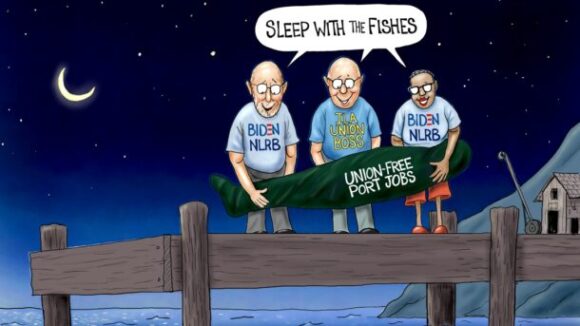
To top ILA bosses’ fury, union-free state employees do a share of the work at ports in three Right to Work states. But thanks to Biden NLRB appointees, those workers’ jobs may soon be scuttled!

Yes, they can do it. But, thanks to the National Right to Work Foundation’s Janus Rights victory, public sector employees cannot be forced to give up their constitutionally protected Right to Work. Wisconsin Radio Talk Show Host (WISN) Vicki McKenna…
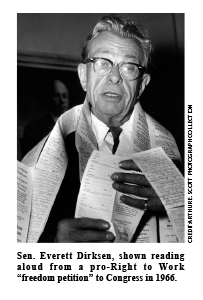
‘Impossible’ Victory Was Made Possible by Grass-Roots Activism (Click here to download the June 2015 National Right to Work Newsletter) Next month marks the 50th anniversary of the 221-203 vote in the U.S. House of Representatives to rubber-stamp…

Panel Exposes Harm Inflicted by Federally-Imposed Forced Unionism (Click here to download the June 2015 National Right to Work Newsletter) As this newsletter edition goes to press, the U.S. House Committee on Education and the Workforce is expected…

Why did Indiana Congressman Ray John Madden (Democrat) tell Sam Donaldson he was try to repeal 14(b) – State Right to Work authorization? “One of the things that I campaigned on was [eliminating] 14(b), because there’s industry flying out of Indiana…
In the current issue of USA Today, Paul Davidson reports that, for a variety of reasons, the U.S. “is becoming a manufacturing hotbed for dozens of foreign companies in aerospace, energy, chemicals and other sectors.” (See the link below for…

Jeff Jacoby, a columnist for The Boston Globe, blasts Big Labor's "shameless pretext" for fighting without abandon against Right To Work Freedom: SOON -- PERHAPS AS EARLY AS TODAY -- Gov. Mitch Daniels will sign legislation making Indiana the nation's 23rd right-to-work state. Labor unions angrily oppose the change, but their opposition has no legitimate or principled basis. State right-to-work laws, authorized by the Taft-Hartley Act of 1947, are not anti-union. They are pro-choice: They protect workers from being forced to join or pay fees to a labor union as a condition of keeping a job. In non-right-to-work states, employees who work in a "union shop" are compelled to fork over part of each paycheck to a labor organization -- even if they want nothing to do with unions, let alone to be represented by one. Laws like the one Indiana is poised to enact simply make union support voluntary. Hoosiers can't be required to kick back part of their wages to the Republican Party or the Methodist Church or the Animal Liberation Front; the new measure will ensure that they don't have to give a cut of everything they earn to labor unions, either. Most Americans regard compulsory unionism as unconscionable. In a new Rasmussen survey, 74 percent of likely voters say non-union workers should not have to pay dues against their will. Once upon a time, labor movement giants like Samuel Gompers, a founder of the American Federation of Labor, agreed. "I want to urge devotion to the fundamentals of human liberty -- the principles of voluntarism," declared Gompers in his last speech to the AFL in 1924. "No lasting gain has ever come from compulsion." Those words can be seen chiseled on Gompers's memorial in Washington, DC. So as a matter of by-any-means-necessary expediency, it is easy to understand why Big Labor long ago embraced what liberal scholar Robert Reich (who served as Bill Clinton's secretary of labor) dubbed "the necessity for coercion." In order "to maintain themselves," Reich said in 1985, "unions have got to have some ability to strap their members to the mast." Or, as Don Corleone might have put it, to make them an offer they can't refuse. But is there any ethical reason -- any honorable basis -- for the union shop?
Jeff Jacoby, a columnist for The Boston Globe, blasts Big Labor's "shameless pretext" for fighting without abandon against Right To Work Freedom: SOON -- PERHAPS AS EARLY AS TODAY -- Gov. Mitch Daniels will sign legislation making Indiana the nation's 23rd right-to-work state. Labor unions angrily oppose the change, but their opposition has no legitimate or principled basis. State right-to-work laws, authorized by the Taft-Hartley Act of 1947, are not anti-union. They are pro-choice: They protect workers from being forced to join or pay fees to a labor union as a condition of keeping a job. In non-right-to-work states, employees who work in a "union shop" are compelled to fork over part of each paycheck to a labor organization -- even if they want nothing to do with unions, let alone to be represented by one. Laws like the one Indiana is poised to enact simply make union support voluntary. Hoosiers can't be required to kick back part of their wages to the Republican Party or the Methodist Church or the Animal Liberation Front; the new measure will ensure that they don't have to give a cut of everything they earn to labor unions, either. Most Americans regard compulsory unionism as unconscionable. In a new Rasmussen survey, 74 percent of likely voters say non-union workers should not have to pay dues against their will. Once upon a time, labor movement giants like Samuel Gompers, a founder of the American Federation of Labor, agreed. "I want to urge devotion to the fundamentals of human liberty -- the principles of voluntarism," declared Gompers in his last speech to the AFL in 1924. "No lasting gain has ever come from compulsion." Those words can be seen chiseled on Gompers's memorial in Washington, DC. So as a matter of by-any-means-necessary expediency, it is easy to understand why Big Labor long ago embraced what liberal scholar Robert Reich (who served as Bill Clinton's secretary of labor) dubbed "the necessity for coercion." In order "to maintain themselves," Reich said in 1985, "unions have got to have some ability to strap their members to the mast." Or, as Don Corleone might have put it, to make them an offer they can't refuse. But is there any ethical reason -- any honorable basis -- for the union shop?
In Virginia, voters get a choice between Obama’s Former-Democrat National Committee Chairman and chief Obamanomics cheerleader Tim Kaine or freedom champion Former-Governor George Allen. George Allen has championed freedom for for employees from forced-dues as Governor and U.S. Senator. His…