At an education town hall meeting in New Jersey, a teacher from Clifton asks what can be done to give New Jersey union teachers back the right to choose what political causes their union dues support. Their rights are being violated by the National Education Association union leaders. Michelle Rhee and Gov. Chris Christie makes a compelling case for Right to Work laws.
New Jersey Education Union Director Vincent Giordano, who according to tax returns makes $550,000, was asked about why poor families should not have school choice to move their kids from failing public schools. In response, he shrugged and said, “Well, life’s not always fair and I’m sorry about that.” Life isn’t fair for workers in the Garden State because union bosses like Giordano can grab union dues money from their paychecks without permission.
Forced-dues continue to fill the coffers of unions, as well as, union presidents’ and politicians’ pockets according to this recent study by the Commonwealth Foundation:
Government Unions and Forced Dues
- Almost half of government workers in Pennsylvania are union members, compared to 9.3 percent in the private sector.
- Pennsylvania is a forced union state, meaning that workers can be forced to join a union or pay a [so-called] “fair share fee” just to keep their job. Most government units in Pennsylvania are “agency shops,” with a specified union to which workers must pay a fee.
- When state and local governments automatically deduct dues and fair share fees from government workers’ paychecks—as is the practice in Pennsylvania—employees have little or no say in how their money is used.
Union Bosses
- Union bosses collect hefty salaries derived from member dues and fair share fees. In most cases, the salaries are several times the average union member’s annual pay.
![]()
- While acknowledging that budgets were tight, AFSCME Council 13 President David Fillman got a 6 percent raise in 2010, making his salary higher than Gov. Tom Corbett’s.
- Dues and fees often go towards expensive conferences, outings and junkets. For example, in 2009-10 the Pennsylvania State Education Association—the state’s largest public sector union—spent:
- More than $250,000 on a board of directors retreat in Gettysburg.
- More than $89,000 for a “political institution meeting” at the Radisson Penn Harris in Camp Hill, Pa.
- $20,000 for advertising in the Pittsburgh Steelers Yearbook.
- Almost $5,900 at Kimberton Golf Club and more than $5,100 at Concord Country Club in Chadd’s Ford.
Political Activity and Lobbying (more…)
Posted in: AFSCME, Do Union Bosses Speak, Economics, Education, Exclusive Representation, Forced Dues, Forced-Dues for Politics, Government Grants to Unions, Legislation, NEA and Affiliates, Pennsylvania, Public Employee Monopoly Bargaining, Right to Work, SEIU, Teacher Unions, UFCW
According to Michigan’s Capitol Confidential, teachers may soon have the right to choose whether they want to pay union dues rather than being forced to pay ever increasing dues without a choice. Others are asking, When will the rest of Michigan’s workforce have the same choice?
From Jack Spencer:
Chances look good for passage and enactment of legislation to provide right-to-work status for Michigan public school teachers. Under the measure, called the “Freedom to Teach Act,” teachers would no longer be required to join or support a union as a condition of employment.
At the end of last week, Senate Majority Leader Randy Richardville, R-Monroe, announced the measure on Michigan public television’s “Off the Record,” and asserted that he strongly supported it. The legislation is expected to be formally introduced Tuesday or Wednesday.
Posted in: AFT and affiliates, Education, Government Grants to Unions, Intimidation Tactics, Legislation, Michigan, NEA and Affiliates, Public Employee Monopoly Bargaining, Public Employees, Right to Work, Right To Work States, Teacher Unions
Unemployment in double digits for years. Debt as far as the eyes can see. No job growth. Bailouts for major industry. Potential bankruptcy for cities and towns. This is the state of Michigan’s economy.
Gov. Rick Snyder is trying to take the bull-by-the-horns enacting legislation to appoint Emergency Managers with broad powers.
Guess who refuses to recognize the stark reality of the state’s finances?
Big Labor. The state’s teacher’s union is considering a strike.
Subscribe to The National Right to Work Committee® Website Updates by Email
Posted in: AFT and affiliates, Economic Impact of Unionization, Forced-Dues for Politics, Government Grants to Unions, Intimidation Tactics, Labor Organizations, Legislation, Michigan, NEA and Affiliates, Organizing, Political Activity, Public Employee Monopoly Bargaining, Public Employees, Union boss power, Union Work Rules
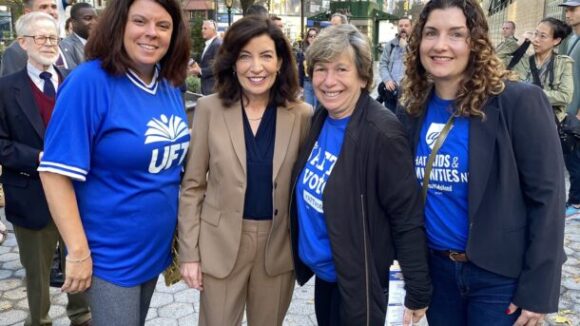
The New York Daily News reports that “As nearly 5,000 city teachers face the ax, their union shells out millions of dollars on feasting, boozing and partying, the Daily News has learned. Free-spending United Federation of Teachers brass last year spent nearly $1.4 million for the UFT’s 50th anniversary gala at the Hilton - complete with a movie, a book and a paperweight.
Records show they:
- Ponied up $514,000 to 16 separate caterers.
- Dropped $278,417 on the annual Teachers Union Day ceremony at the Waldorf-Astoria.
- Bought $6,100 in gift baskets from a lower East Side candy store – and plowed $179,000 into training retreats at a Connecticut resort boasting golf, scuba diving and aqua aerobics.
In one amazing feat of spending, they shelled out $114,870 for annual “coffee supplies” at their five offices across the city – paying the Coffee Distribution Corp. on Long Island $324,000 over three years, records show.
And while most New Yorkers spend hours trying to find a parking space, the UFT rents 25 slots in Brooklyn’s Renaissance Plaza Garage for members at an average annual cost of $75,000 over three years.
“I’m not going to apologize for spending money to service our members,” said UFT President Michael Mulgrew.
From Hot Air (http://hotair.com/archives/2011/02/26/nea-to-double-member-dues-contribution-to-political-war-chest/)
Amid substantial membership losses and a $14 million shortfall in its general operating budget, the National Education Association plans to double each active member’s annual contribution to the national union’s political and media funds.
Currently, $10 of each active member’s NEA dues is allocated to these special accounts. The more than $20 million collected each year is then disbursed to state affiliates and political issue campaigns – such as last year’s SQ 744 in Oklahoma. A portion of the money also pays for state and national media buys to support the union’s agenda.
But the most recent numbers show NEA lost more than 54,000 active K-12 members since this time last year. Coupled with less-than-expected increases in the average teacher salary – upon which NEA dues are based – the union will find itself with $14 million less revenue than it had planned. This includes about $500,000 less in the political and media funds.
Faced with unfriendly legislatures and governors seeking to roll back the union’s influence, the NEA Executive Committee decided to double down – literally. It proposed raising each active member’s assessment to $20, effective in September 2011. The union’s board of directors ratified the decision, and it will go before the NEA Representative Assembly for a vote this July in Chicago. If passed, NEA’s national dues for teachers will total $178.
The increase in the assessment has a five-year sunset clause, but this is just eyewash, since the last time the contribution was doubled – from $5 to $10 in 2004 – it also had a five-year sunset clause. The 2007 NEA Representative Assembly made the $10 contribution permanent.
NEA is already the top political campaign spender in the nation. This increase will give the national union an additional $40 million per election cycle. The increase alone is larger than all but two other groups spent during the entire 2007-08 cycle.
Right to Work Makes Major Gains in State Legislative Contests
(Source: December 2010 NRTWC Newsletter)
It takes a lot to convince Iowa citizens to oust a sitting governor. Until this fall, the last time a Hawkeye State chief executive failed to get another term after seeking one was in 1962! But over the past four years, Big Labor Democrat Gov. Chet Culver wore out Iowans’ considerable patience.
On November 2, he was one of 13 incumbent governors on the ballot across America. Eleven of these incumbents won, but Mr. Culver lost by a hefty 53% to 43% margin.
What had Chet Culver done to receive such a harsh rebuke from normally amiable Midwesterners? He tried to gut Iowa’s popular Right to Work law — and he was sneaky about it.
After saying nothing about the Right to Work issue during his successful 2006 gubernatorial campaign, Mr. Culver announced, almost as soon as the votes were counted, his support for legislation imposing forced union dues and fees on Iowa workers as a condition of employment.
Since Mr. Culver’s fellow Democrats controlled substantial majorities in both chambers of the Iowa Legislature that greeted him upon his inauguration in early 2007, it seemed Big Labor’s stealthy scheme to bring back forced unionism to the state six decades after it had been banned would succeed.

For four years, Gov. Culver tried to help union bosses extract forced fees from workers who choose not to join. But freedom-loving Iowans first thwarted him legislatively and then defeated him at the polls.
But the National Right to Work Committee and the Iowans for Right to Work Committee were already mobilizing resistance.
Pro-Right to Work Iowan Stopped Forced-Union-Fee Schemes in 2007 and 2009
Even before the new Legislature convened in January 2007, the National Committee began sending out a series of statewide and targeted mailings to members and supporters in Iowa, with a focus on selected House and Senate members in vulnerable seats. (more…)
Posted in: AFL-CIO, AFSCME, Elections, Forced-Dues for Politics, Government Grants to Unions, Iowa, Labor Organizations, Legislation, Monopoly Bargaining, NEA and Affiliates, NRTWC Newsletter, Political Activity, Public Employee Monopoly Bargaining, Public Employees, Right to Work, Union boss power