From the National Right To Work Legal Defense Foundation:

Case emphasizes need for a Right to Work law in the Aloha State

Honolulu, HI (April 27, 2012) – With free legal assistance from National Right to Work Foundation staff attorneys, two Honolulu Hilton employees have filed federal unfair labor practice charges against the UNITE HERE Local 5 union.

Grant Suzuki and Daryl Sakugawa don’t belong to Local 5 but can still be forced to pay union dues and fees as a condition of employment because Hawaii lacks a Right to Work law. However, the Foundation-won Supreme Court precedent Communication Workers v. Beck holds that nonunion employees cannot be forced to pay for union activities unrelated to workplace bargaining, such as political lobbying or members-only activities.

In December 2011, Suzuki and Sakugawa received a breakdown of union financial expenditures from Local 5. According to the union’s books, both employees were forced to contribute to a variety of activities outside the scope of workplace negotiations, including UNITE HERE political lobbying and a union strike fund.

To read the rest, click here.


The National Right to Work Committee relies on your voluntary contributions to fund its programs. Please chip in a $10 contribution today.


Share

Union Due’s Pay for Party

With the Democrat National Committee (DNC) short on funds needed for their national convention this year, Democrat party leaders have turned to Big Labor Bosses to ask that they their union treasuries pay the freight.

In 2008, Big Labor kicked in $8 million in forced-union-dues money for the convention. This year it looks like the DNC needs more than that. Bloomberg’s Hans Nichols reports that “the three-day convention will culminate in Obama’s re-nomination in Bank of America Stadium on Sept. 6. So far, the host committee in Charlotte is roughly halfway to its $36.6 million goal.”

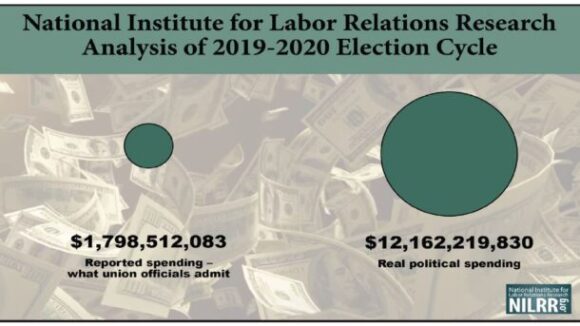
There is little doubt Big Labor political spending will easily top the $1 billion mark this election-cycle. What’s a few million more between friends?


The National Right to Work Committee relies on your voluntary contributions to fund its programs. Please chip in a $10 contribution today.
Share

The Chicago Way — Teacher’s Prepare to Strike

You need to install or upgrade Flash Player to view this content, install or upgrade by clicking here.

Teachers at more than 200 Chicago schools overwhelmingly favor a plan to walk off the job in protest, Chicago Teachers Union Boss Karen Lewis said. Lewis said a number of schools have taken “mock strike votes,” and the majority favor work stoppage, NBC Chicago reports.  She says that teacher’s are being treated with “disrespect.”

Share

Move Over Occupy Wall Street, SEIU’s 99% Spring is taking over

The beginning of (forced-dues financed) SEIU Propaganda Minister Scott Courtney’s e-mail is pictured above.  He proclaims that it is “a chance for all of us to come together to create a new future for our country.” Not much of a claim since there is no “old future” for any country.  SEIU’s rhetoric is as incendiary as it is nonsensical, and all-the-while illustrating that SEIU considers itself a political party and not a mere labor union.

Perhaps it is time for the IRS to evaluate SEIU’s political spending and see it has been paying ts “fair share” of taxes.  With many college students with out jobs and the money to pay for gas in this Obama Economy, maybe SEIU will attract a few soldiers for its war on workers and their rights to have Right To Work freedom.

What is SEIU teaching at its indoctrination camps? “This week, we’ll learn to tell the story of our economy and what went wrong.”

Will SEIU teach that under the two SEIU supported Democrat congresses our economy imploded?  That SEIU backed President Barack Obama, Senate Leader Harry Reid, and House Speaker Nancy Pelosi piled more debt on college students and kindergarteners than ever in the history of America while simultaneous destroying the economic engine?

Will SEIU teach about its involvement, as well as, the AFL-CIO’s and ACORN’s involvement in the housing crisis?  You know the answer; it is NO.  But, if you don’t have the facts on your side, the next best thing is propaganda or as SEIU calls it: The 99% Spring.

More from the SEIU’s 99% Spring e-mail:

Last year, from the Wisconsin workers who took over their state capitol to Occupy Wall Street, we saw a new movement in America using direct action to highlight the unprecedented inequality that’s destroying our country.

The 99% Spring is our chance to maintain and broaden that changemaking [sic] energy, and learn how we can take action to challenge corporate power, end tax giveaways to the 1%, fight the influence of money in politics, and create an economy that works for all of us.

This week, we’ll run more than 900 trainings in union halls, living rooms, places of worship [does this impact tax status?], community centers and parks.


Share

Big Labor Bosses Getting Nervous?

Big Labor bosses in Wisconsin are getting nervous.  You can sense it from this Associated Press story lamenting that the unions may have bite off more than they can chew by attemtping to recall Gov. Scott Walker.  AP quotes Greg Junemann, boss of the Professional and Technical Engineers union as saying ”If we lose, it’s a shot in the mouth.  We can survive it, but we’ll be reeling.”

“After devoting so much effort, energy and funds to the recall, unions have to show positive results or it will be judged to be a sign of a weakened labor movement,” said Gary Chaison, professor of industrial relations at Clark University in Worcester, Mass. “If they can’t win in one of the most liberal states, where can they win?”

Good question.  Now you know the stakes.


The National Right to Work Committee relies on your voluntary contributions to fund its programs. Please chip in a $10 contribution today.


Share

WP’s Lane: Progressives Should Oppose Big Labor’s Walker Recall

From the “progressive” Washington Post’s Charles Lane, an exposure of public sector unionism and its unequaled influence on elected officials and the cost of government:

Of course, collective bargaining in the public sector is inherently contrary to majority rule. It transfers basic public-policy decisions — namely, the pay and working conditions that taxpayers will offer those who work for them — out of the public square and behind closed doors. Progressive Wisconsin has a robust “open meetings” law covering a wide range of government gatherings except — you guessed it — collective bargaining with municipal or state employees. So much for transparency.

Even worse, to the extent that unions bankroll the campaigns of the officials with whom they will be negotiating — and they often do — they sit on both sides of the table.

More from Lane:

The furious drive to oust Walker is the sequel to last year’s dramatic battle over his plan to limit collective bargaining by public-sector unions. Walker won that fight, despite tumultuous pro-union demonstrations in and around the state capitol and a boycott of votes on the bill by the Democratic minority in the legislature. (more…)

Share

SCOTUS Reviews Big Labor’s Forced Political Interest-Free Loans

From BigGovernment.com:

In Knox v SEIU, the illogic of requiring non-union members to provide interest-free loans for Big Labor political activities comes under the Supreme Court’s scrutiny. In this National Right To Work Legal Defense Foundation case, Dianne Knox and others challenge SEIU’s special assessment to members and non-members for its “$12 million Political Fight-Back Fund” that essentially created a mandatory interest-free loan from non-members’ dues for political purposes they opposed.

From the Supreme Court transcript:

Supreme Court Justice Alito: Suppose that the proponents of Propositions 75 and 76 had come to the union and said, would you please give us an interest-free loan for money because we want to use this money to — to persuade the electorate to enact these; but don’t worry because we’re going to pay it back right after the election, when we’ve achieved our electoral ends. Would — would the union provide the money because it’s all going to come out in the wash?

SEIU Lawyer Jeremiah Collins: I — I really can’t answer that question. I don’t know. I –

JUSTICE ALITO: Well, I — gee, I really doubt that you — that they would. But what’s the difference? If you look at this from the perspective of a nonmember who doesn’t want those ballot initiatives to be defeated, saying that we’re going to give you your money back — we’re going to use your money to achieve a political end that you oppose, but don’t worry because we’re going to give it back to you next year after we’ve achieved our political end — how does that solve the problem? [Emphasis added]

Indeed, how does this solve the problem of compulsory unionism? It does not. Forcing people to pay dues or make political contributions against their will, even if some portions maybe refunded, fails to meet any standard of personal liberty. While union bosses may ridiculously argue that monopoly bargaining is a labor union’s civil right, without Right To Work Freedom, it tramples on individual freedom. In this case, SEIU trampled on the political freedoms of Dianne Knox and all the other non-union members under the SEIU-State of California’s collective bargaining agreement.

This case is worth watching and a decision in this case likely will be issued soon.


Share

Minnesota Judge Dale Lindman ruled that Gov. Mark Dayton’s Executive Order (EO) calling for the unionization of child care providers is unconstitutional.  Judge Lindman, an appointee of Gov. Arne Carlson, said that Gov. Dayton’s EO is “an unconstitutional usurpation of the Legislature’s right to create or amend laws”, which “is a violation of the Separation of Powers principle.”

The Examiner called it s “stinging defeat for Gov. Dayton, AFSCME and the SEIU.”   Judge Lindman said that the BMS doesn’t have statutory authority through Chapter 179 to get involved in this dispute, adding that they only have the authority to mediate in employer-employee disputes.

HotAir.com weighs in on the news:

Dayton attempted to bypass the state legislature in this effort by declaring through executive order that day-care centers that indirectly receive state aid through their clients are in effect public-sector workplaces — a definition not found in law or in legislative intent.  In fact, as Gary Gross points out, it arguably contravenes state law.  That way, Dayton could order an election that would allow his union allies to force their way into day-care workplaces, including many independent operations, and start extracting dues on a massive basis.

I use the word extreme for a couple of reasons.  First, it fits; had Dayton succeeded in his imposition of public-worker status, the precedent established would have been so broad as to threaten the very notion of a private-sector workforce altogether. (more…)

Share