Indiana Law Turns Heat on Michigan

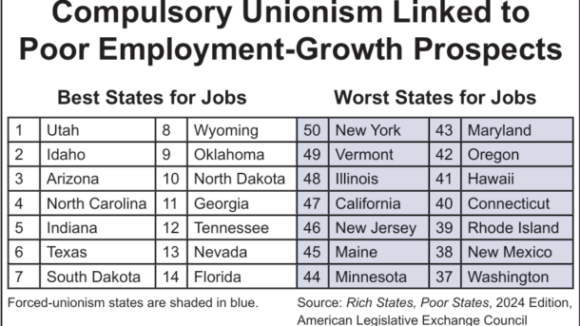
Time Magazine suggested that Indiana’s enactment of Right to Work protections for workers is a big deal primarily because of it is the first state in the “Rust Belt” to seek to attract jobs and business through Right to Work laws.  We may be seeing evidence that they are right.

The Associated Press reports “Indiana’s move to become the Rust Belt’s first “right-to-work” state has intensified debate over the issue in neighboring Michigan.  Supporters of right-to-work laws say they’re more convinced than ever that Michigan should take a similar step in hopes of lessening union clout and attracting more jobs.”

Unfortunately for Michigan workers and taxpayers, Gov. Rick Snyder (R) has decided to punt on the issue.  Other members of the Republican establishment including the Senate Majority Leader Randy Richardville are unwilling to cross their union boss allies.  This is an effort that will take time.  But have no fear, in order to compete, Michigan will need to break big labor’s stranglehold on its economy with a Right to Work law.  As the Rolling Stones sung, “time is on our side.”

Mix: Indiana Rejects Forced Unionism

Writing for the Investor’s Business Daily, National Right to Work President Mark Mix summarizes what our victory in Indiana really means:

For the past two weeks, Big Labor bosses around the country have had their eyes on the Indiana capitol — watching in horror as the General Assembly passed a right-to-work bill with commanding majorities.

The passage of Indiana’s right-to-work law is an extraordinarily bitter defeat for the union brass. Less than a year ago, despite the fact that Hoosiers had elected substantial pro-right-to-work majorities to both chambers in 2010, union strategists remained confident they could preserve the forced-unionism status quo.

Last year, union bigwigs convinced the entire Democratic caucus of the Indiana House of Representatives to flee the state for five weeks in order to deny the body a quorum it needed to bring up and pass right-to-work legislation. Big Labor clearly believed whatever it lacked in legislative numbers it could make up for in zeal.

But polls showed Hoosiers overwhelmingly disapproved of the “fleabagger” tactic, and right-to-work supporters kept turning up the pressure on Republican Gov. Mitch Daniels and GOP legislative leaders to fight back against Big Labor.

Thanks to legislation passed after last year’s walkout, House members failing to show up to do their jobs when the General Assembly is in session may be hit with $1,000-a-day fines.

In the opening weeks of the 2012 session, House Democrats went public about their reluctance to jump over a cliff again for the union hierarchy. Finally, on Jan. 24, House Minority Leader Pat Bauer announced an end to his caucus’ boycott of the bill. It passed the next day.

Ever since, the caterwauling by Big Labor and its allies has resounded across the state. But what’s so bad about a law that merely says an individual shouldn’t be forced at the workplace to support financially an organization that he or she doesn’t believe acts in his or her interests?

Rather than address this question, union propagandists skirt it. Union officials never act contrary to the interests of any employee, they implicitly argue. Any employee who says otherwise they brand as a hypocritical “freeloader”! (more…)

Indiana Gov. Daniels: Right to Work Working Already

In an interview with Politico, Indiana Gov. Mitch Daniels touted the benefits of the newly enacted Right to Work law saying his phones were “ringing off the hook with companies wanting to come to the state since he signed the measure.”

“Indiana has by every reckoning the 5th or 6th best business climate in the country, and now it gets a little better,” said Daniels on Fox News. “The phone began literally ringing yesterday afternoon with companies wanting to come to our state.”

Indiana Workers Demand Their Right to Work

From the Wall Street Journal:

The labor reform story of the year is unfolding in Indiana, which Republicans who dominate the legislature are trying to make the nation’s 23rd right-to-work state. Democrats are resorting to the old run-and-hide ploy, but this could be a huge economic boon to the Hoosier State.

Big Labor portrays right to work as a radical change, but it merely lets individual workers decide if they want to join a union. In non-right-to-work states, workers typically must pay union dues once their worksite is organized—whether they want to pay or not. This enhances union clout and the cash to dominate state politics.

Many industrial and manufacturing businesses only consider right-to-work states as locales for expanding their operations. The nearest right-to-work state in the Midwest is Iowa, so Indiana could set itself further apart from such high-tax, unionized havens as Illinois and Michigan.

According to Chief Executive Magazine’s annual CEO survey, Indiana has climbed to sixth from 16th among state business climates, thanks to reforms since 2004 under Governor Mitch Daniels. But the state’s biggest liability remains its labor market. A Forbes survey last year ranked Indiana 34th in business climate, partially because of a dismal 44th rank in labor “supply,” which includes unionization.

Democrats in the state House played hooky for three days last week in an effort to deny a quorum for voting on the law. They returned to work yesterday after Democratic leader B. Patrick Bauer acknowledged that they “can’t stay out forever.” House members face penalties of $1,000 per day for walkouts longer than three days, so the obstruction could get expensive. (more…)